
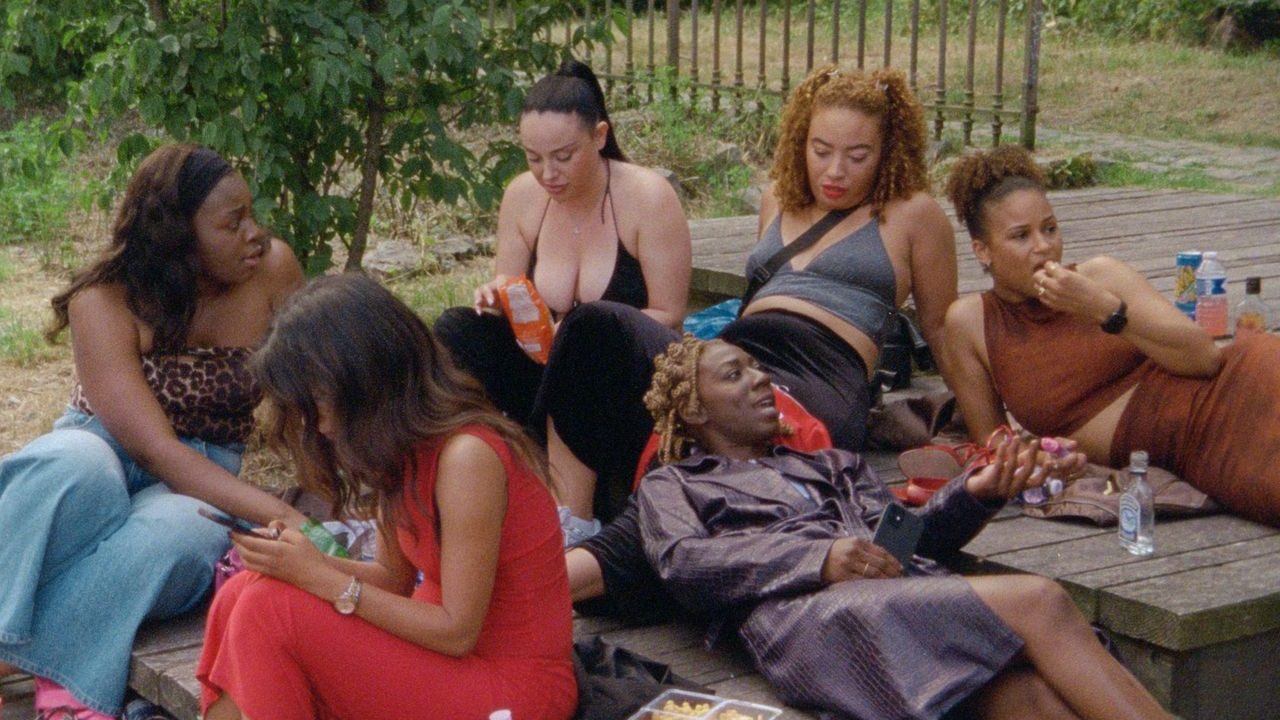
In her debut solo feature, Shana sees director Lila Pinell explore self-destruction, identity, and toxic cycles through a protagonist who feels constantly at odds with both herself and the people around her. Played with chaotic unpredictability by Eva Huault, Shana drifts through France balancing work, nights out, family tensions, and drug deals for her incarcerated boyfriend Moses (Yassine Stein), whose influence over her life remains impossible to escape even from prison. Following the death of her Moroccan Jewish grandmother Marie (Geneviève Krief), Shana inherits a family ring said to ward off bad luck — but after she sells it, her already unstable life only seems to spiral further.
Much of the film exists in the space between family, identity, and self-destruction. Shana’s strained relationship with her mother Yolande (Noémie Lvovsky) and her disconnect from her family’s traditions create the sense of someone who no longer feels grounded anywhere. Whether she is arguing during a family dinner, spiraling through nights out, or recklessly throwing herself deeper into Moses’ world, there is a constant feeling that Shana is searching for independence while simultaneously sabotaging any chance she has at finding it. It’s a theme that felt familiar, and will likely feel familiar to many young adults still trying to figure out who they are outside of family expectations, relationships, and the versions of themselves they present to the world, making Shana’s uncertainty feel palpable throughout the film.
What Pinell captures particularly well is emotional instability of Shana and her situation. The film moves rapidly between arguments, emotional breakdowns, impulsive choices, and shifting relationships, mirroring Shana’s chaotic mental state in a way that often feels authentic, frustrating, and occasionally magnetic all at once.
That constant momentum, however, also became one of the film’s biggest frustrations for me. The story rarely slows down long enough to let its emotional moments settle or to fully build investment in the people onscreen before jumping into the next conflict. Over time, watching Shana repeatedly return to the same destructive patterns became more exhausting than compelling, particularly because the film spends so much time circling the same behaviours without allowing much emotional progression in between.
The film’s style further adds to this feeling of disorientation. Its heavy use of close-ups, overlapping dialogue, and chaotic conversations creates an intimacy that clearly feels intentional, at times it comes at the expense of clarity, making certain scenes difficult to follow.
While the ending hints at growth, with Shana seemingly reclaiming some sense of herself, I’m not sure the emotional payoff fully landed for me after spending so much time watching her repeat the same cycles. Still, there is clearly a strong directorial voice behind the film, even when it loses itself in its own chaos. I’d be interested in seeing more of Pinell’s work, as well as the original short film adaptation, which received significant critical acclaim. There are strong ideas throughout Shana, and I could easily see this story benefiting from a tighter and more focused format.
Shana was screened at the 2026 Cannes Film Festival. Image courtesy of The PR Factory.
