
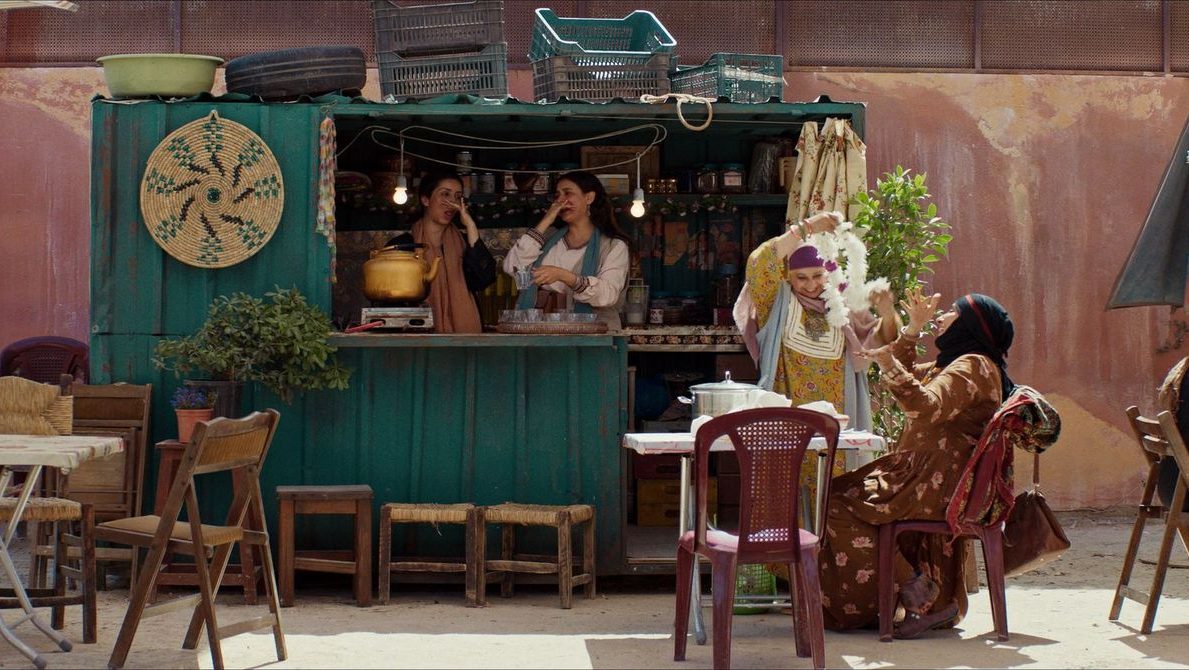
A petrol-station that has become a safe haven for women. This is Layal’s business, in a strict territory in war-town Yemen. A fictional character and story, that is inspired by real-life experiences. What comes from this story, in the film called The Station directed by Sara Ishaq, is a beautiful tale of love and perseverance, and the lengths that siblings and communities will go to in order to protect the lives of the ones they love the most.
The film opens with chanting as the credits roll, voices repeating, “The people want electricity and water! O citizens, awaken! Corruption ends today!” The translated captions tell us specifically that these are “Women chanting”. What follows is a black screen with text to set the scene. We are in Yemen, a country torn by war that was once known for its abundance. The film is inspired by real-life experiences, but the specific story and rival groups of the film depict a parallel world that has been “caught in an endless cycle of fighting”.
From here, we are introduced to Layal, busy in the morning getting her 12-year-old brother ready for the day, as she opens her petrol station. But this station is unique. It is a women-only station that has become a rare safe haven in a country filled with war. No weapons, no cell phones, no politics, and no men are allowed. It is a place where women can safely purchase petrol. But is is also a place where laughs are shared, victories are celebrated, gossip is spread, and contraband like contraceptives are obtained. It is a place the women are able to be removed from the politics of their situation – even if fighter jets still pass low over their location, always carrying the threat of a dropped bomb.
This safe-haven is quickly threatened with the arrival of Um Abdallah. Layal lives in a strict province, despite her not sharing the same beliefs as them. Um Abdallah tells Layal that all boys must join a military bootcamp at 12, or pay a hefty fee. With no other choice, Layal reaches out to her sister, Shams, who fundraises for the opposing side and lives outside of their strict province to ask for money to save their brother Laith. When Shams arrives, the sisters’ conflict must be put to the side to save their brother.
There are clearly a lot of moving parts here. Once Shams arrives, she berates Layal for staying in the strict territory that puts Laith in danger. Layal reminds her that he would be taken from them if they tried to leave through the checkpoints. Not to mention how the aspect of the women-only petrol station fits in to the siblings’ story, which easily could have made for a full feature with exclusive focus itself. But despite all that is going on here, it all works so well together. Each aspect of the story, from the opposing sides and Shams’ chaperone, to Layal’s station and all the different women we meet within it, all contribute to the bigger story of Laith and his sisters. The different personalities of each character complements the ending so well, and each character is used perfectly to reach an ending that feels both heartfelt and grave.
Heartfelt, as we are reminded of the strength of a family. Not only Laith and his older sisters Layal and Shams, but also the family that has been chosen within the petrol station. Yet still grave, as we are removed from the safety of Layal’s haven and thrown into the real life experiences that so many people have lived through and are currently living through in Yemen, and so many other war-torn countries around the world. This may be set in a parallel Yemen with different names for opposing groups, but the point is the same.
With all these moving parts, the film never drags. It is well paced, and with so much going on, it is always moving forwards. The screenplay works so that each moving part is working towards the same goal of Layal and Shams keeping Laith safe, so we always feel like we are progressing to some shared final outcome, regardless of the many characters and personalities introduced in the film.
Along with the strong screenplay and pacing, the performances are all well done, with believable and strong chemistry between the family members, as well as the women using the station. We can feel the camaraderie between friends, as well as the love between sibilings in each aspect of the film.
It is a sign of a good director and writer that I feel inspired by a film without ever feeling preached at. The Station lives in realism, giving us hope while also reminding us that there is still so much work to be done. The film itself is almost a safe haven for us watching. One that reminds us of the love in the world so torn by hate. One that shows us a community that looks out for each other, despite every external pressure trying to pit each person against another.
There is so much darkness we are shown in The Station, but in this darkness director Sara Ishaq lets us see small glimmers of hope, reminding us that the road ahead is long, but there is still a safe haven at the end, and at moments along the way in places we never expect to find them.
The Station was screened at the 2026 Cannes Film Festival. Image courtesy of The PR Factory.
