
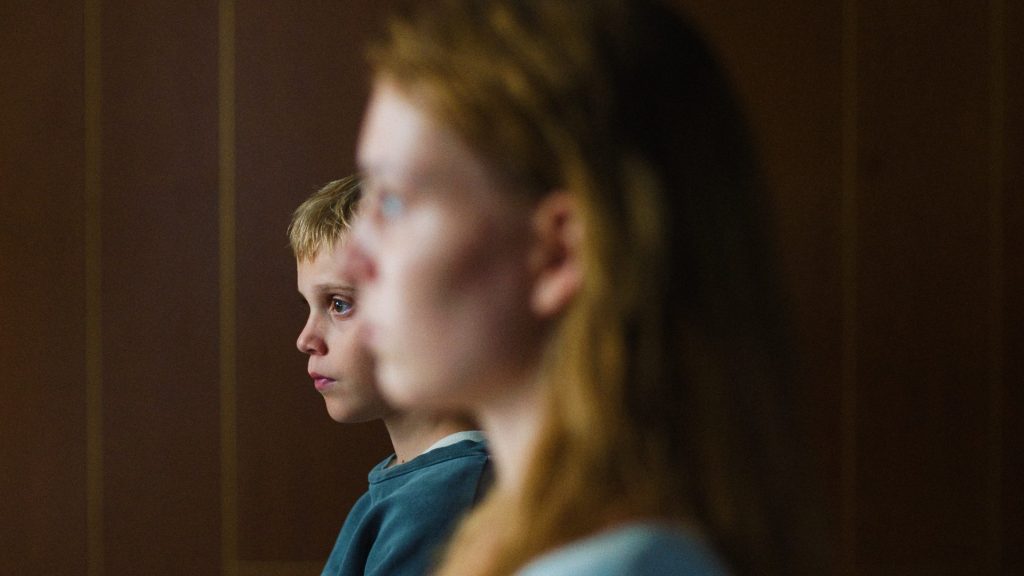
It is a strange thing to think how people might experience the exact same thing, yet each ends up coping with it in a vastly different way. Mees Peijnenburg’s A Family explores a parent’s divorce, and how the two children, Nina and Eli, respond to their new lives so differently. Rarely has a film about a divorce been presented almost solely through the stories of the children in the family, and Peijnenburg inspires brilliant performances from his leading children, Celeste Holsheimer as Nina and Finn Vogels as Eli to allow us all to relate, in some way, to the fracturing of this family and how we deal with a separation as the ones feeling out of control in it.
The film opens on two children. They are Nina and Eli, and they are speaking with an adult whose face we never see. This adult reads what they have written, about their lives. Wanting to stop moving between houses. Feeling guilty enjoying their time with one parent, when the other is not around. The voice then asks them, with who would they like to live. Back home, we cut to a title card, “Nina”. For the next 30 minutes, we watch older sister Nina as she struggles to make sense of her new life, moving between homes and feeling unsettled everywhere she goes, desperately hoping her relationship does not become like that of her parents. We then jump back in time with the second title card, “Eli”, where we watch almost the same series of events take place, but this time how Eli experienced them. Being thrown around as a pawn in his parents separation, unable to voice what he wants in fear of accidentally supporting one parent’s fight over the others. Exploring how two children experience the same life in vastly different ways, A Family ends with a coming together of siblings in a family torn apart.
The first standout of the film is the remarkable performances from Celeste Holsheimer as Nina and Finn Vogels as Eli. This film’s narrative relies so heavily on its performers, as their performances also allow the unique structure of the film to work to the extent that it does. Holsheimer fully captures your attention in the beginning of the film with her strong personality and teenage angst, and Vogels’ quiet and subtle performance in the second half continues to ground the film in realism as we watch two children struggle as their family is forced apart.
Speaking of the performances, these work in tandem with Peijnenburg’s unique story structure, following the two children one after the other, telling the same story from two different perspectives. Peijnenburg speaks about his interest in how people can encounter the same situation, but experience it and react to it in completely different ways. He wanted to highlight this by taking a close look at two siblings living under the same roof, with the same parents, and examine how they each individually responded to their situation. Through his characters Nina and Eli, we see two completely different, yet understandable, reactions to the fracturing of their family. We see how they internalize the events around them differently, but still how much they need the same thing; someone to be by their side on this tumultuous journey.
Further, there are so few films about the breaking of a marriage that are viewed through a child’s eyes. Here, we so clearly see the impact that the fighting and arguments have on the child, without feeling as though we have to choose a side between the mother and father. Instead, we are aligned with the children, exploring how Nina and Eli become mirrors of their parent’s actions, or doing all they can to avoid becoming them.
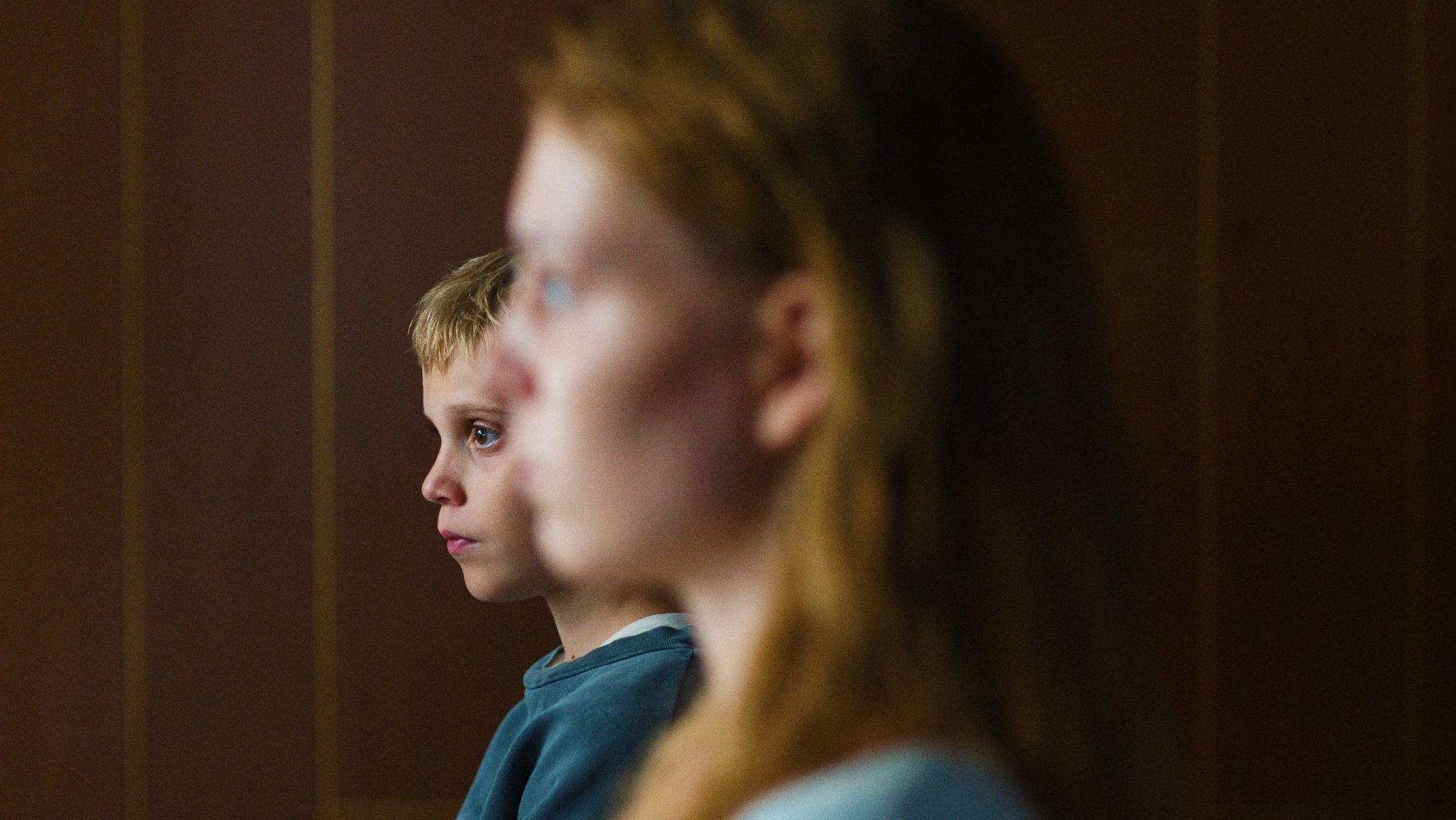
The cinematography and sound design also captures this fracturing so well, always foregrounding the child we are following, keeping the parents in the background. We overhear arguments from the foyer while we wait with Nina, or remain in the restaurant with Eli while we listen to a phone call happening outside. We feel their distance from their parents through these methods, while we also feel the all-encompassing nature of their seemingly never-ending battle, a negativity that seeps in to every corner of the film that infiltrates every aspect of the children’s lives.
It is nothing new to explore the breaking-up of a couple in a film. What is fresh in Mees Peijnenburg’s A Family is how it takes this fracture and looks at it through the point of view of the children of the couple getting divorced. Telling the same story in parallel from the split perspectives of children Nina and Eli, the performances from Celeste Holsheimer and Finn Vogels work together with the strong direction, cinematography, and sound design to create this devastating portrait of a family falling apart, and siblings coming together.
A Family was screened at the 2026 Berlin International Film Festival. Image courtesy of Paradise City.
 After Screening Cinema