
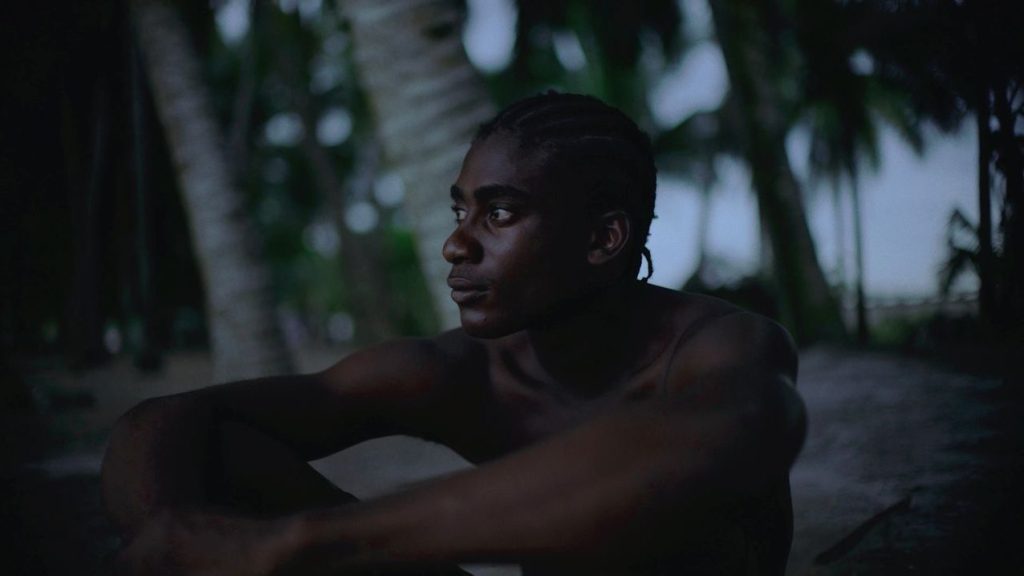
A search for belonging that spans generations and continents, Jeremy Comte’s Paradise looks at how we fill the void inside of us when each of us has different access to resources and time. Telling two stories in parallel, one following Kojo in Accra, Ghana and the other following a mother and son in Quebec, Canada their stories that seem impossible to intertwine eventually do, leading to one that uniquely brings the groups of people together. Though the stories interconnectedness is a cool aspect, it does fail to really say much in the end, and loses steam in the third act, playing in to a lot of common stereotypes, making me question the real motivations of the film.
The story opens with Kojo, a young man in Accra, Ghana. Helping his father with his business, he is left on his own when one day his fisherman father disappears at sea during a storm. Left with no support, he joins a gang, trying to find community and a way to work when no one else is extending a hand. On the other side of the world is Tony. Recently 18, he spend his days skateboarding with his friends and working to save money, when his mother, Chantal begins dating an American ship captain online. Suspecting that this man is the father that he never met, Tony peeks into his mother’s personal life, causing events to unfold that will leave all three characters changed forever.
In general, and especially in the first two acts, the film uses a really unique story structure of showing us these stories in parallel without being very clear on how they will overlap. We see the differences in how these two men, Kojo and Tony, are being raised, of similar age but across the world, and how much their environment helps or hinders their upbringings. Knowing that soon the stories will become connected, the first act flies by, as we try to guess what events will bring the two young men together. As the story continues, this connection becomes much more integrated into the story, making it a satisfying story structure.
I think that aside from this unique structure that is slowly revealing to the audience, the overall film suffers from falling much too hard into common stereotypes. Specifically, there are moments in each of the three characters stories that we should, narratively speaking, feel sympathy for the characters. But when comparing how the information is presented, we are given so much information and screen time of Tony and Chantal going through their moments of struggle, making up the majority of the time they are on screen. In comparison, a lot of the plot points that would encourage our sympathy for Kojo, specifically what happened after his father disappeared is left to the imagination. We jump in time to make grand reveals in the story, leaving an obvious but integral struggle on Kojo’s part off the screen.
This aspect and some others alike had me questioning who the film wanted its audience to align with. Why are we not shown the life that led to Kojo’s involvement in the gang as much as we are shown Tony and Chantal’s struggles as Tony’s curiosity and Chantal’s decisions leave them in an entirely different difficult position, but still told parallel to Kojo’s story.
On top of this, by the time the third act comes around, it is difficult to support many of the characters in the decisions they are making. In what seems like an attempt to give finality to the film and completely merge the two stories, some decisions the characters make are so naive that it is hard to identify with them at all, pushing us away from the work that the first part of the film accomplished in its withholding of information.
Overall, Paradise captured my attention. Cleverly withholding information about how the story of Kojo, in Ghana, and Tony and Chantal, in Canada, would overlap, it made for a unique film of two stories told in parallel that would eventually come together. But in the end, the film still fell victim to playing too deeply into common stereotypes, making decisions of the characters, by the end, very difficult to support.
Paradise was screened at the 2026 Berlin International Film Festival. Image courtesy of The PR Factory.
 After Screening Cinema