
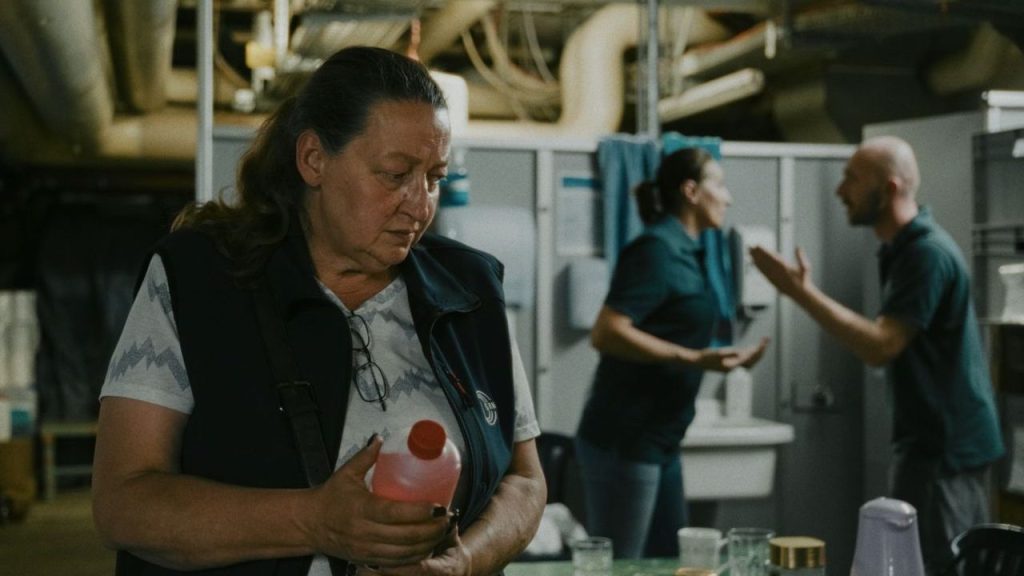
A small community used to study how change can start with just one person, I Understand Your Displeasure enters the world of a group of cleaners in Germany. Led by one unsympathetic Heike who must work to live, she juggles being a manager with her own personal life and new workplace demands. With stunning realism and a strong central performance, the film touches on relevant themes like aging in the workplace and workplace reform that will feel familiar to so many watching.
Heike is a manager at a cleaning company. She must deal with a boss who is always pushing her to keep his subcontractors happy, forcing her to fire her own employees so he can continue to make more money. Faced with difficult decisions when having to let go of people she cares about, Heike begins to crack under the pressure, questioning the state of her workplace and whether real change is ever really possible.
The main standout here is the central performance of Heike from actor Sabine Thalau. There is rarely a shot she is not in, capturing her unsympathetic character in a way that encourages us to have sympathy for her. We see her struggles through her everyday actions like cleaning schools and doing laundry, performed with subtleties that reflect her state of mind and mood.
There is also a cool use of the camera here, often remaining behind our workers and specifically Heike, placing us in their footsteps directly. This is not a film that aims for us to look at cleaners through rose-coloured lenses. The work is hard, and we see the ins and outs of their days as if we are in their shoes, making the difficult moments that much harder as we have experienced their hard work alongside them.
The film also gives a unique insight into immigration in Germany, as Heike is encouraged by her boss to keep subcontractors happy. The subcontractors often hire workers who are illegal immigrants or on specific visa’s, who face more difficulties with finding work and then are often paid at a much lower rate. So since these subcontractors take advantage of their staff, Heike’s boss hire’s the subcontractors and their workers for much less than he would pay a full time employees while still charging his clients the full rate, pocketing more money. Heike is asked, then, to fire full time employees with legal working status, so the big boss can give their jobs to the subcontractors. The film then turns the discussion of immigration on its head, placing the blame of lost work on the money hungry CEO’s rather than the immigrants themselves, a unique and much more realistic portrayal of the state of minimum wage work.
I will say that I did feel like the film was missing some kind of “breaking point” in the middle of the film. It does become a bit monotonous as Heike continues to feel the pressures of her work and her home life, until it just seems like she has had enough. Maybe a bit more drama would have made the second act a bit more lively, but this mundanity also allows the film to remain realistic and grounded in real and lived experiences.
With Heike’s character, there is a unique ending that empowers the viewers to believe in the work done by a few individuals for change and good. Workplaces can be reformed, and thus society can be changed, as long as there are still those willing to risk what they have worked towards and to use their knowledge to support the next generation. Featuring an older character like Heike in the leading role, it shows a new side of this change, and the experience of being older and wanting change. Heike is often encouraged to remain complacent, but knows she must use what she has learned and the skills she has acquired to build a new future for herself and those younger than her. I do wish that the film’s portrayal of the discussion between the generations played a bit more of a central roll, but it was still present.
While I do wish the film had more of a build-up to some kind of climax a bit more, I Understand Your Displeasure uniquely portrays the working class, praises the work of immigrants, and shows us workplace reform is possible through a realist lens. The central performance is the highlight of the film, and the camera supports the films themes to place viewers directly in the lives of Heike and those working for her, to inspire us through this small group of people that change really is possible.
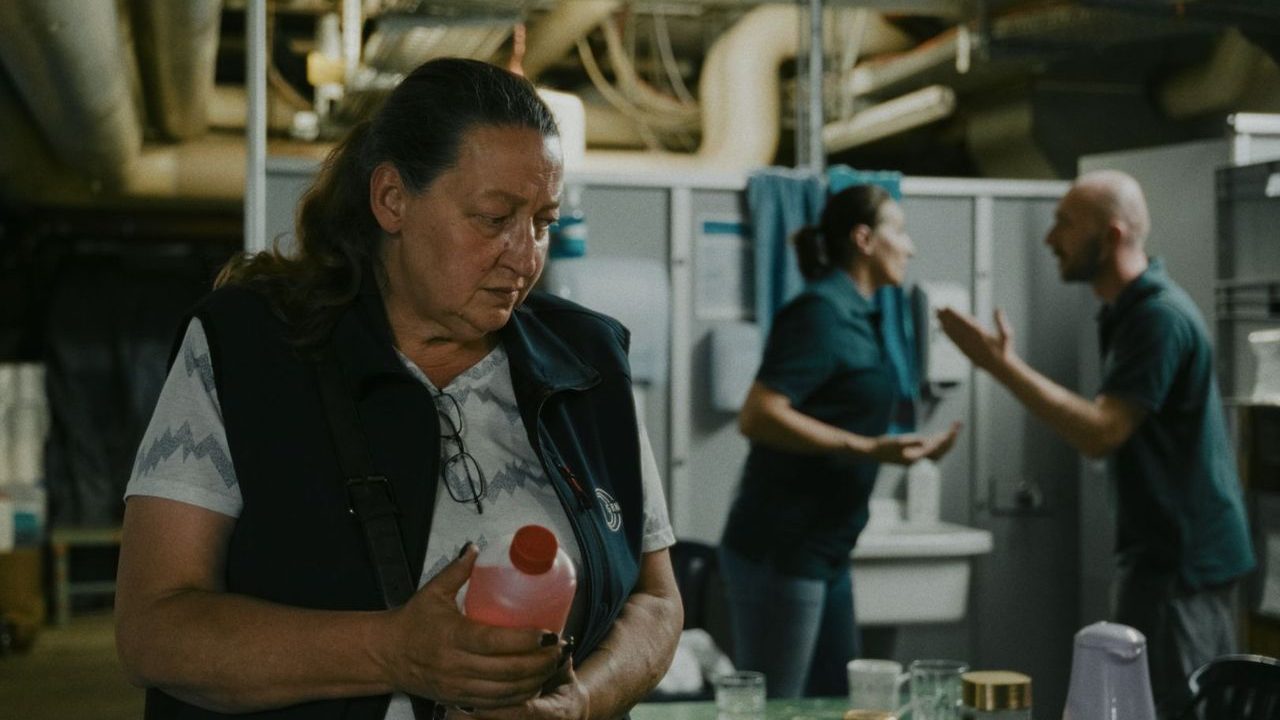
I Understand Your Displeasure was screened at the 2026 Berlin International Film Festival. Image courtesy of The PR Factory.
 After Screening Cinema