

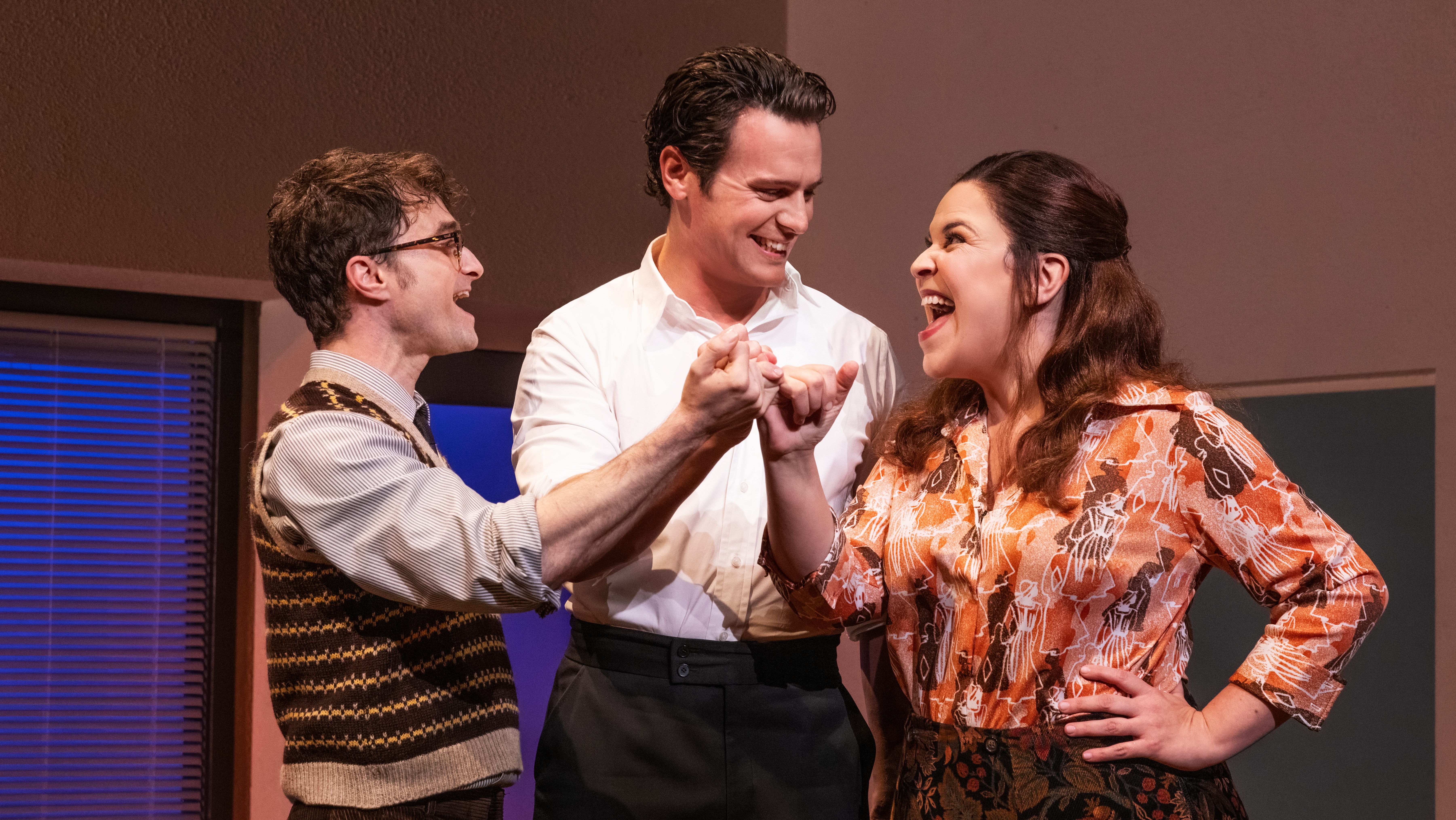
In a world where tickets for popular live shows are becoming more impossible to get by the day, pro-shots are becoming a more accessible way to guarantee a seat to the hottest shows, given that the seat is in your local movie theatre or your own home. From concert films becoming more popular to bring the hottest ticket to movie theatres, the pro-shot musical, a professionally recorded version of a live stage show, seems to still remain a one-off, but is becoming more popular as word of stellar broadway performances continues to grow. Following the release of Hamilton in movie theatres and Come From Away on Apple TV+, the pro-shot of the Tony Award winning 2023 broadway revival of Merrily We Roll Along, directed by Maria Friedman and starring Jonathan Groff, Daniel Radcliffe, and Lindsay Mendez is coming to theatres this December. Making this Sondheim musical-told-in-reverse more accessible to all, it is able to capture the musical, sometimes not to its fullest potential, but this does not hold it back from shining a light on the star performances at the heart of this musical, and making live theatre more accessible to all.
Merrily We Roll Along originally premiered on broadway in 1981, and tells the story of three friends, Frank, Mary, and Charley. The film begins in 1977, and is told in reverse, moving back in time to show how their friendship devolved over 20 years. Frank, at a opening-night Hollywood part in 1977 now obsessed with fame and fortune hears the name Charley and the party goes silent, as Mary tells us how the three used to be the best of friends with Charley and Frank creating musicals together, until time and changes slowly tore them apart. Throughout the 2.5 hour runtime, the years continually roll back, as song and spoken lines tell their story of friendship, and how they came to reach the jagged relationship we are introduced to in the first moments of the show.
It is hard for me to start with any kind of critique without first acknowledging my excitement to be able to watch broadway musicals without having to physically travel to New York City. I wrote in the past about the Hamilton pro shot, and the importance of making a live musical more accessible. A lot of my original praise still stands, as I applaud those behind the scenes for making their musical last forever by sharing the pro-shot with the general public, something that still remains behind many closed doors for most broadway musicals, staying more of a one-off experience that we are lucky to get yet have come to never expect.
As a result of this pro-shot, award winning performances like that of Groff and Radcliffe, as well as award worthy performances from Mendez are made more accessible to larger audiences around the world, not just simply contained to a single theatre in New York City. In a story of friendship and relationships, the performances of the three main actors carry the story, their stage presence pulling you in deeper with every scene and roll back of the years, keeping us invested in their relationship wondering how their characters came to be the way they are. Their singing abilities are stunning, and their on stage chemistry radiates true friendship that is beautifully captured by the cameras on stage.
In terms of the direction, I will say that though cameras on stage providing the the close-ups and different camera angles allow us as the audience to see a stage play from a new perspective and to get a personal look at the actors expressions, it does slightly take away from the overall experience of watching a stage play on an at home screen. Where the true experience would have us sitting in a single seat, taking in everything at once, I feel that this pro-shot does miss out on capturing a lot of the stage direction and intentional mise-en-scène, instead often choosing to make shorter shots that cut frequently to direct our attention instead of letting us choose for ourselves. Comparing it to something like the Hamilton pro-shot, which is a show that does have a lot more dancing, this one lacks many long shots that really capture the full stage. The Hamilton pro-shot does cut close to our characters, and change camera angles quite frequently, but I know I definitely did not feel like I was missing out this much while watching, wondering what the whole staging looked like.
One obvious example comes during one of the final songs, Opening Doors, where the three main characters speak through the phone about what they have been doing in the year. On the stage play, I assume we would see them all sitting separately on the stage, clearly in different rooms but sharing the space, quickly whipping our heads as the lines jump between the three players in their state of panic and frustration. In the pro shot, we instead cut to close ups of each character quickly as they say their lines. Not once throughout this song do we see them all sharing the stage, until they are diegetically in the same room, taking away from the overall experience and original choice to have all three characters share the stage.
Many more examples like the prior one exist throughout the pro shot, making it hard to tell what they were going for with this pro shot in general. If the goal was simply to share the story with the new performances, then it was achieved. But if it was preserving the very essence of the stage performance given by these players, creating the atmosphere of live theatre in the home, then I unfortunately think it failed.
Not because of anything the actors did, or any way that the songs were performed, but instead because of how the film was directed, cutting to close-ups and rarely ever showing us the full stage as we would see it from the audience, even going so far as to not show the final bows of the cast that would inevitably have taken place on a broadway stage, choosing to instead cut directly to the end credits. For these decisions, it does leave me questioning what the goal of Friedman was with the film version. I cannot speak on her direction choices in the live stage play, but I do know that for myself a lot didn’t work with her pro shot version of her Tony winning revival.
I also some overall issues with the original story of Merrily We Roll Along, which is not the fault of Friedman as she is merely adapting a successful musical here, but I still feel would be beneficial to mention. The women in the musical are quite underdeveloped compared to their male counterparts, especially looking at the leading woman Mary, and how I finished watching this musical feeling like I barely knew anything about her or the successful novel she wrote. She has this love for Frank, but this is severely underdeveloped and feels quite thrown in to try to make her more important but instead simply serves to try to develop Franks character. Similarly, many other female characters feel written quite one-dimensionally to simply develop the stories of their male counterparts, including Gussie and Meg.
It is hard to be critical of a broadway revival that is filmed professionally from the stage to be shown in local movie theatres and from the home. On the one hand, I am so happy that theatre and live performances are being made more accessible to those who are unable to travel around the world to see specific performances. On the other hand, it is a bit of a let down when the pro-shot seems to miss out on capturing the overall essence of watching a live show with a stage and multiple players doing their thing at once. Even still, it is a strong production of the beloved show, and the performances from Radcliffe, Groff, and Mendez carry the show through the more shaky aspects of its story and film direction that will make the film an enjoyable time for musical lovers to finally have access to one of the most sought after tickets of the 2023-2024 broadway season.
Merrily We Roll Along will be released in theatres in Canada on December 5. Image courtesy of Sony Pictures Classics.
 After Screening Cinema