
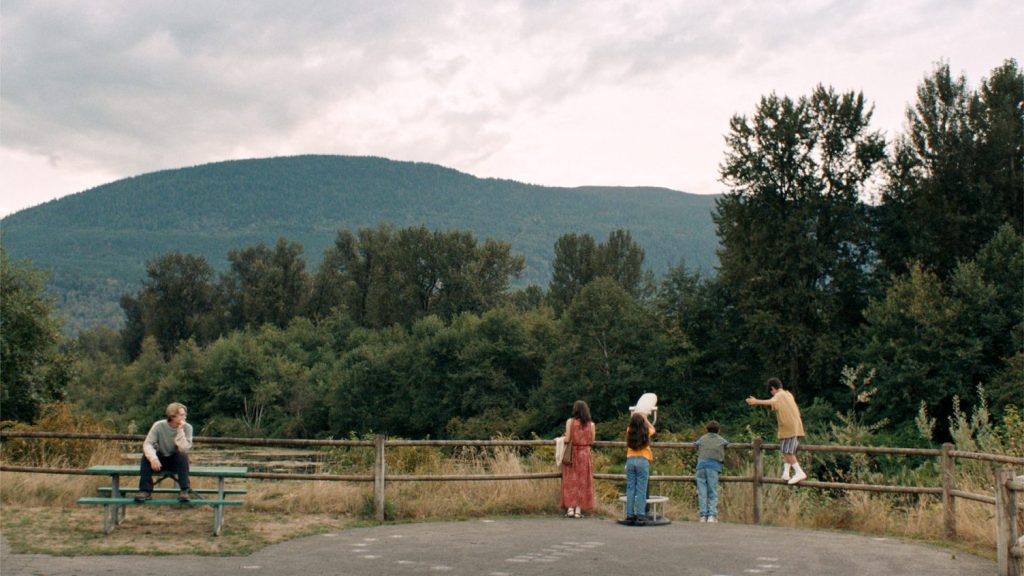
The future of Canadian cinema has never looked brighter, after the Canadian premiere of Sophy Romvari’s feature debut Blue Heron, winner of the First Feature Film Competition at the 78th Locarno Film Festival and the Best Canadian Discovery Award at the 50th Toronto International Film Festival. Based on her own childhood, the film follows a family who have relocated from Hungary to Vancouver Island, from the point of view of the youngest daughter, while the eldest son deals with behavioural issues in their new home. Innovative and fresh throughout, the film takes what we have come to expect from films exploring mature themes from a child’s perspective and pushes the boundaries even further, creating a one-of-a-kind exploration of grief, and how we use art in the healing process.
Sasha is 8-years-old, and is the daughter of a Hungarian family who have relocated to Vancouver Island. Her eldest brother, Jeremy, displays signs of increasingly destructive behavioural issues, and we watch from her perspective as herself, her family, and her brother try to adapt to their new environment while also trying to help him through this difficult time. They all attempt to keep him from causing more damage to those around him, and to his family and their dynamics overall.
Sophy Romvari who directs and write Blue Heron should be immediately praised for all that her film achieves. I was initially drawn to the film for my interest in coming-of-age films that use child protagonists to explore adult themes, thinking along the lines of Aftersun and The Florida Project. The beginning of Blue Heron feels similar, like a film that is exploring new topics in a way that I have seen before. Where Romvari takes her third act brings her film from being a great one to one that will change the way many of us look at art about grief and trauma, and interact with art as a whole.
Without speaking too much about this shift that the third act takes, the entire film works so well together as a mediation between guilt and grief. It acknowledges and explores the importance of art in the healing process from loss and trauma, while also exploring the guilt that comes with this. The guilt that artists may feel in the way they are “using” someone lost to create art or to work through their own healing process. Feeling like they are exploiting the memory of their loved one, while also recognizing the importance of their taking part in the art itself. The film never fully states one correct response we should have in this use of art in the healing process, but instead uniquely explores the feelings that many may have in this artistic process, in a film that itself is working as part of its director’s healing process.
As I said before, enough praise cannot be recited for Sophy Romvari and what she was able to achieve in the film. Along with the way her narrative expertly explores the films themes, she also captures Vancouver Island with such elegance and youth, placing us in the shoes of 8-year-old Sasha. The film is expertly paced, achieving some kind of shock-factor in the third act that is unexpected in this kind of film. She works expertly with the actors in the film, especially the child actors playing Sasha and Jeremy, feeling like real aspects of her own life are infused into the film, furthering her messaging on the use of art in one’s own journey of healing.
Speaking on the performances, everyone involved expertly captures their characters and relationships to one another. Eylul Guven as Sasha and Edik Beddoes as Jeremy are promising young actors, while Iringó Réti as Mother and Ádám Tompa as Father have such great chemistry with the children and play off each other so well, crafting the family dynamics that help nail the themes of the film even deeper. Amy Zimmer takes over in the third act, and so effortlessly fits right in, tying the film together so beautifully while playing expertly off of what the cast provided before.
Blue Heron also cannot be spoken about without mentioning its importance in Canadian cinema. While many people groan about watching a Canadian film arguing to instead watch a big Hollywood movie, Romvari not only cements herself as one to watch in the Canadian film space, but also in the film world overall. I really do believe her debut feature Canadian-Hungarian film will be spoken about amongst other great coming-of-age films. The film is complex in both its narrative and its subject matter, and will challenge viewers not only with the themes is presents, but also in their own relationship with film and art as a whole, something important on an international scale, that everyone will be able to recognize.
Blue Heron pushes the boundaries on what coming-of-age films can do, and uniquely explores themes of grief, and guilt over how we use art to work through our own trauma. Being Sophy Romvari’s feature film debut, she clearly becomes one to watch, creating a film that I hope will be spoken about as one of the great Canadian and coming-of-age achievements in film.
Blue Heron was screened at the 2025 Toronto International Film Festival. Image courtesy of TIFF.
 After Screening Cinema