
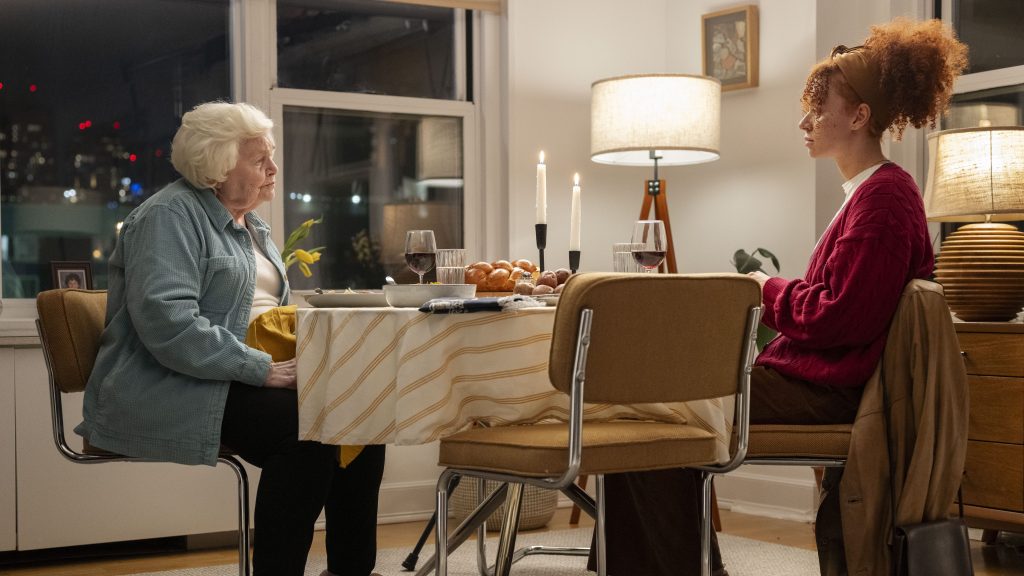
Following her leading role in 2024’s Thelma, June Squibb is back to grace our screens again in 2025 starring in Scarlett Johansson’s directorial debut, Eleanor the Great. Touching on similar aspects of loneliness and grief, Johansson’s film, written by Tory Kamen, takes a unique spin on classic themes, placing Squibb as Eleanor, an older woman who lies about being a holocaust survivor after the death of her friend. Never making Eleanor the villian, June Squibb is a great leading lady, but the film never feels like it challenges her or the genre, making it a very forgettable film.
When Eleanor’s best friend dies, she moves back to New York City. Attending a class at the community centre, she accidentally takes part in the holocaust survivors support group, and lies saying that she, too, survived the holocaust, repeating stories that her best friend told her about her time in a concentration camp during World War 2. When a young journalism student hears her story and wants to feature Eleanor in her story about survivors, Eleanor agrees, continuing the lie until it spirals out of control.
Going into this film, I had no idea the turns it would take. Thinking it was a film about an older woman returning to New York City after years away, nothing really prepared me for seeing her lie about being a survivor of the holocaust. This is all to say, this aspect of the story is quite high stakes. It is a tremendous lie to undertake as part of the script, and one that needs to be handled with grace so it never becomes something that could be looked at as problematic. Thankfully, the story succeeds at using this tremendous lie to speak on grief and loss, highlighting Eleanor’s loneliness through this lie she tells, to touch on grief in aspects of every character’s lives, not just Eleanor’s.
At the core of this film is June Squibb, whose performance captures the light inside this aging character that is never dulling. She portrays Eleanor’s graceful aging in a realistic way, highlighting the anxieties many older adults feel about being forgotten or about losing loved ones, without it ever becoming a very depressing or too heavy performance. Her on screen chemistry with Erin Kellyman, who plays the young journalism student Nina, is strong, and the highlight of the film.
In terms of the story told about Eleanor, it does always stay very safe. It does not ever push the boundaries on stories about older people, even for how serious the story and the lie Eleanor tells is. For something this big, its safety definitely holds it back. It uses a very unique narrative point to continue to say the same things that a lot of films about older adults always do, including the difficulties of losing loved ones and the way that grief is expressed by different people. Eleanor tells the lie in an effort to remain relevant and close to her friend who has passed, to keep her story alive. But but focussing less on this and more on other character’s grief, rather than this more unique aspect of carrying on someone’s legacy and memory after they die, the point is never really reached until the very end, when it maybe too late for some viewers who already lost interest.
It is nice how the film never makes Eleanor the villian. It never makes any character the villian, as we are all reminded of the things grief makes us do, and how much we put into keeping someone’s legacy and memory alive. It is fresh in this way, but does sometimes come off as a older adult remake of Dear Evan Hansen, without much else to add other than more ways that loneliness can impact a person.
It is a difficult fim to find anything else to say about because on top of the more basic themes it touches on like grief and loneliness, it does not really even challenge what it is like to get older. It touches on grief from the unique point of view of keeping someone’s memory alive, but even these more touching moments feel quite rushed in the end, ending up feeling like a montage of realizations rather than any pointed exploration of a society that forgets about large parts of its population so easily, including older people and survivors of war. There is the classic second act reveal and tensions, but even this seems to gloss over the more difficult discussions between characters, often feeling like it resolves things off camera that would have been much more strongly explored on camera.
Johansson also shows promise in her direction skills, but like the story, she really does not take any risks. Her pacing respects Eleanor and the story it tells about older adults, but she could be doing more cinematically to make this work stand out from other films of its genre and themes, to try to do something that does not feel like imitation.
Overall, Eleanor the Great will be enjoyed by a lot of those who watch it. I just don’t really think it will be remembered. It is a nice story, but does not do anything to further push outside of what has come to be expected from stories about older adults, which is unfortunate.
Eleanor the Great will be released in theatres in Canada on September 26. Image courtesy of Mongel Media.
 After Screening Cinema