
It is a story we all know and a name we have all heard. Hamlet, the prince, or in its full title for the stage, The Tragedy of Hamlet. A story of revenge and redemption, of loss and family. William Shakespeare’s longest play, and one that author Maggie O’Farrell envisions having come as a result of the death of his son, Hamnet. Director Chloe Zhao adapts O’Farrell’s novel, Hamnet, to a film of the same name, one that tells the story of Agnes (Anne) Hathaway and her husband as they fall in love, start a family, and experience the loss of their son Hamnet. Crafting one of this years most beautiful and devastating films, Zhao expertly focusses each act of her film on Agnes and her experiences, drawing expert performances from her lead actors to tell O’Farrell’s heart-breaking story of love and loss.
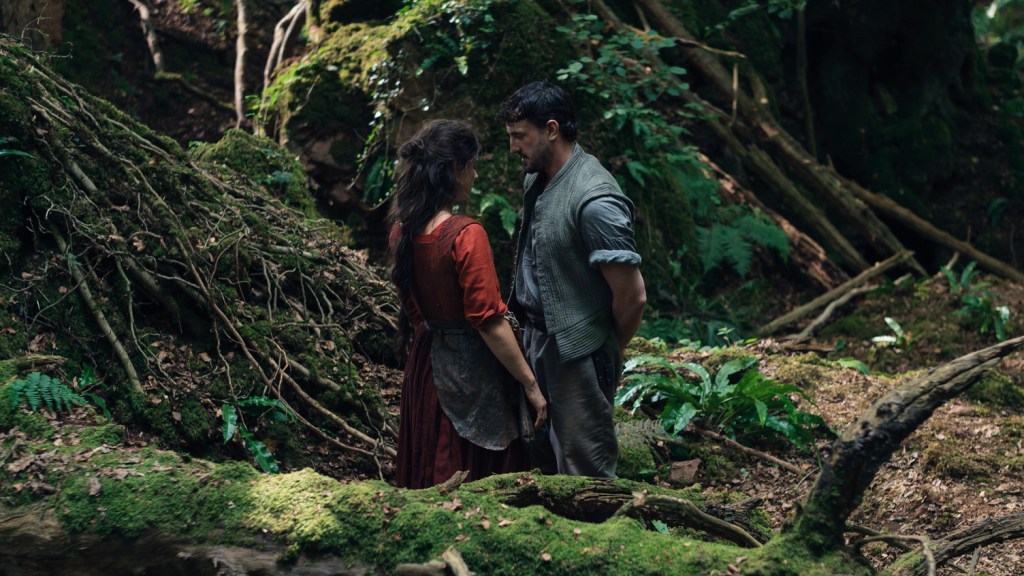
We are introduced to Agnes (Jessie Buckley) in the forest, surrounded by nature as she tends to her garden and her hawk. It is here she meets the young man William (Paul Mescal), whom she quickly falls in love with, despite the disapproval from her family and brother (Joe Alwyn). Becoming pregnant, the two get married and begin their family, before welcoming their three children to the world, their oldest Susana, and their youngest, a set of twins named Judith and Hamnet. As William begins to go into London from the country to work in the theatre, Agnes adapts to becoming a mother, as her youngest daughter falls ill with the bubonic plague. When the young Hamnet wishes to trick death so it takes him instead of his twin sister, his wish comes true, and Agnes and William are faced with the brutal loss of their child. This loss leads to tension between the two, as William continues to travel into London, using his grief to write his play for the stage, titled Hamlet.
An astounding feat of Zhao’s direction in this film will first to be the performance she captures from Jessie Buckley as Agnes. Buckley is absolutely devastating as Agnes, filling her with such youth but also a strong sense of self throughout the film. It is beautiful that Agnes starts off in the film already with a strong sense of who she is. Instead of watching her find herself and grow up, we see an already knowing woman, who is instead changing as she falls in love and grows up with both William and her children. She is portrayed always as a strong and resilient woman, who still has ways to change and improve, but never as someone who doubts herself or her place in the world. It is from here that we get a strong sense of who she is, and Buckley is able to portray this confidence without it ever coming off as pride or arrogance. She defies where she should, while remaining someone we look to for guidance throughout the story.
Along with this, her strength also ensures that we never pity Agnes. It would do this story no good if all we felt was that she was a woman who needed to be lead after the loss of her son. We feel the loss of her son so deeply along with her because we are experiencing the loss through her and with her, rather than feeling bad for her. Buckley and Zhao’s interpretation of Agnes is one that gives her strength, and one that supports her through the hard times, rather than using her to simply elicit sorrow from the audience.
Paul Mescal also delivers a beautiful performance as William, never leaning too far into the tortured artist trope, and Zhao and O’Farrell’s materials work to keep Agnes as the centre of the film, rather than making it a story of Shakespeare. The child performances are also astounding and some of the best I have seen before, with Jacobi Jupe tearing at heartstrings as their young son Hamnet, proving to be one to watch in the future of film.
Hamnet cannot be discussed without also praising director Chloe Zhao’s exceptional work with the camera. Like her other films, the natural world plays a big role in Hamnet. Her direction here treats this world as almost another character, one that Agnes feels so home in. One she deeply understands, and one that makes it so hard to leave when called to London. A world that has taken care of Agnes for so long, crafting nutrition for her family and natural remedies for her children, so that when it can no longer help, and when Agnes loses control and her son dies, we feel betrayed by. We feel this loss so deeply with Agnes not only because of the expert performance from Jessie Buckley, but also because this world in which we have been so immersed in with her has let us down. Nature has betrayed her, a nature that once saved her, and the unnaturality of a mother having to bury her child becomes even more apparent. The world around Agnes that Zhao has crafted helps her to feel authentic, and it also makes the loss of her son hit us, as observers, that much harder.
Zhao’s film is also one that is incredibly human-centred, as we feel we truly understand Agnes and her love for William and their children, and the world around her, in the way that Zhao’s camera captures her. Long shots of her wandering through the woods or playing with her children, or static shots that capture her doing the mundane in the garden. We are immersed in these small moments along with Agnes, allowing us to feel more attached to her life and experiences, growing into love with her as the film runs its course.
Going into the film, I was unsure what to expect. Reading it would be about the death of Agnes and WIlliam’s son, I knew it would be a film heavily about loss. But the story does not centre itself on this loss too much. Instead, we begin with a love story. A young Agnes falling in love with the tutor named William, and their growing relationship as they start their family. It them becomes a film of this love growing, expanding into a mother and father’s love for their children, and a sister and brother’s love for each other. It is only here where we move into the loss, almost halfway into the film. When Judith catches the bubonic plague that Hamnet will die from. It is as much of a story of Agnes and William creating life as it is about the losing of it. It is a love story and a family story that ends in a loss, rather than a story that starts off with loss on its mind. It is a tragic ending to a beautiful story, and one that hits harder because we have experienced the beginning with Agnes, rather than simply being a tragic tale.
With its relation to William Shakespeare’s The Tragedy of Hamlet, we watch in the third act through Agnes as William works on his first play. Returning to London to work directly after Hamnet’s death, he continues writing, to put down on paper all he feels about his loss, regrets, and grief, and his wish to take his son’s place in death. Feelings all unknown to Agnes, she travels to London with her brother (Joe Alwyn) to confront Shakespeare, unknowingly attending her husband’s show, which holds the name of her lost child that no one in the audience is aware of. As they attend the theatre performance, the things that Buckley and Alwyn are able to capture with their face and subtle movements in the audience are expert, capturing the betrayal turned to healing that they are both experiencing in the theatre, watching Shakespeare’s Hamlet.
It would be impossible to tell a story about Shakespeare without some inclusion of his work. As O’Farrell postulates that Hamlet was written in grief after the loss of their son Hamnet, we travel with Agnes to London to see Hamlet. Through Agnes in this moment, watching Hamlet after experiencing her loss, Zhao bookends the film with love, encapsulating the support and community which exists in art and the shared experience of a theatre. The shared experience of watching a performance of a play or a film in a packed room, all experiencing the emotions shared on the stage. Feeling love and loss and grief performed from the hearts of the players on stage, we feel and see Agnes continue to heal as she connects with the actors, and also the others in the room watching the play with her. The camera is placed at times directly in the audience, so we are literally watching Shakespeare’s play with them, peering around heads of those in front of us to see the players shine. We experience the healing act of shared art through Agnes, but also directly with her, sharing the space with her to also work through our own grief of the story we just watched and lived through. In this moment, Zhao reminds us that while this is Agnes’ story, it is also ours too, validating the emotions we have felt over the past two hours, allowing Agnes’ grief to also be ours, and giving us the space to heal alongside her.
For obvious reasons, Hamnet demands to be seen on the big screen. If not for seeing Jessie Buckley’s expressions on the biggest screen possible, then to take part in the healing community of shared theatre and art that director Chloe Zhao and original author Maggie O’Farrell beautifully end the story of Hamnet with. Though Shakespeare’s play is titled The Tragedy of Hamlet in its entirety, Zhao’s beautiful film is simply titled Hamnet, because I would argue, it is not a tragedy. It is instead a story of love, and how love changes and morphs, and can become grief. A story of falling in love, and creating life from this love, and losing life, and slowly healing from this loss, with the help of the community of theatre and the love within a family.
Hamnet was screened at the 2025 Toronto International Film Festival. Image courtesy of TIFF and Focus Features.
 After Screening Cinema