

When the film first premiered, reactions out of the theatre were polarized. Some hailed it as inventive and the film of the year, while others laughed at its attempts to take its titular character seriously amidst the choreography and original songs of the film. From Mona Fastvold, co-writer of the 2024 sensation The Brutalist, this is The Testament of Ann Lee. Starring Amanda Seyfried as Ann Lee, the founding leader of the Shakers religious sect in the 1700s, the film may not live up to Fastvold’s 2024 hit, but the music and choreography keeps it snappy and fresh until the end.
This historical drama musical tells the story of Ann Lee, the founding leader of the Shakers religious sect in the 1700s, believed by followers to be the second coming of Christ in a woman’s body. By their beliefs, if God created all people in his image, then he must come to Earth as both man, Jesus, and woman, Ann Lee.
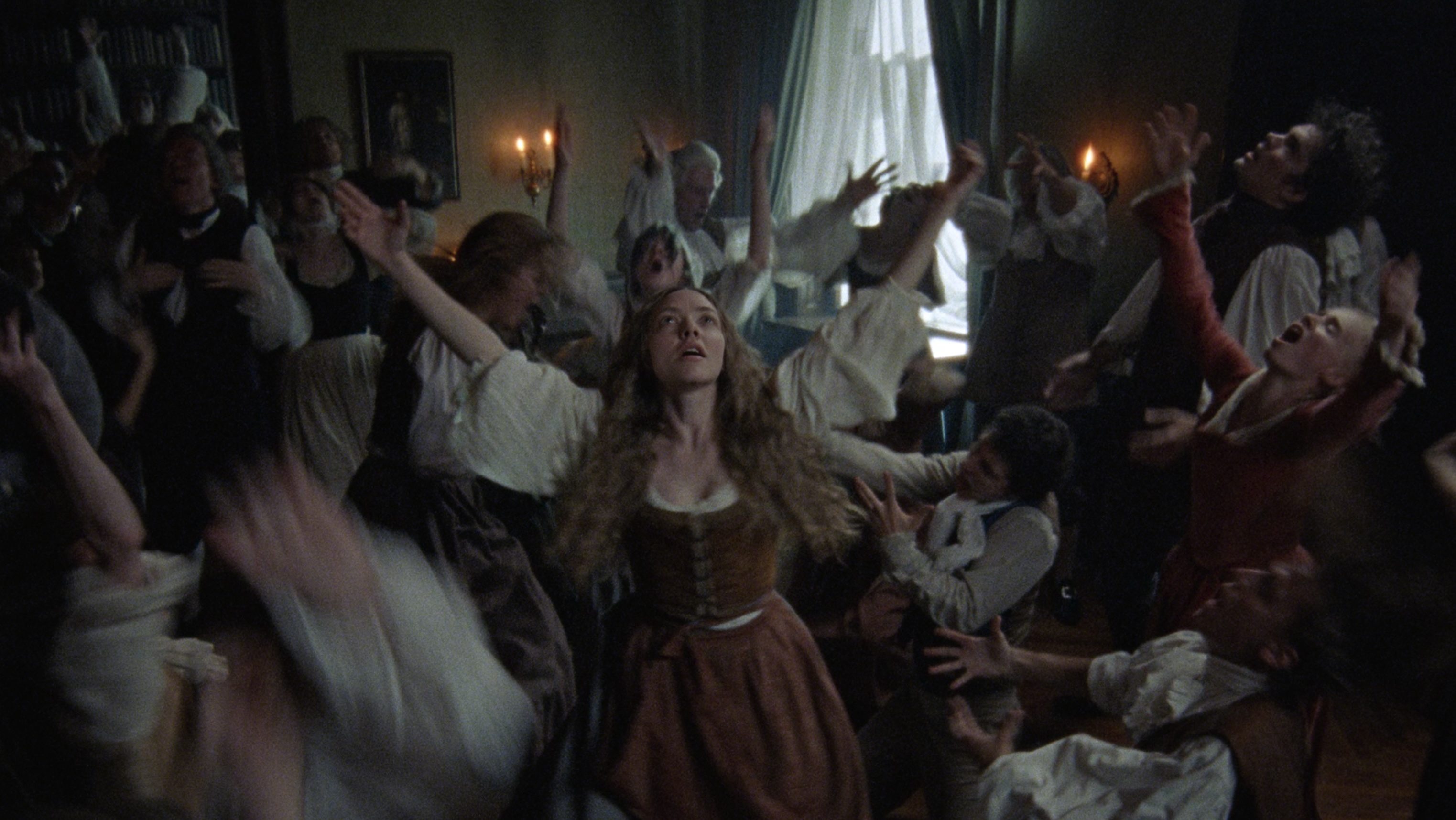
Known for their unique style of worship, the Shakers are recognizable for their energetic and ecstatic style of worship during services. Finding the small group when she was young, Ann Lee became enraptured in the religion, having visions of herself speaking with angels who told her she was God’s female body on Earth. Born in England, the small group heard a calling to America, where Lee and her supporters moved to begin spreading their testimony across the ocean. Practicing a celibate life and living communally, the Shakers lived together as America fought for its freedom from the crown in the late 1700s.
I can’t think about this film without immediately thinking of the score and choreography of the dances. The film is a musical, advertised as such, but I also think it would be too simple to just call this film a musical. You can’t tell the story of the Shakers and of Ann Lee without music. Music and dancing so engrained in their way of worship and religion, this film would do nothing for telling their story without its inclusion. It adds a pulse of energy throughout the film, snapping you back into their world as the notes begin playing and Seyfried begins beautifully singing, even when the film takes a slower turn in the second half.
So while the music and choreography do a lot to make this film what it is, it still does not cover up the fact that the film becomes quite slow and monotonous in the second half. The beginning focusses expertly on Ann Lee, her upbringing told succinctly and her integration into the religion is told with purpose. Once the group travels to America, the film takes a turn for the worse, often feeling like they are repeating over and over again the story of their attempts to grow as a religion, never further adding anything to the titular character’s growth other than an impersonal look at her history.
It is hard for me to talk about true historical stories and “biopics” for lack of a better word, because I am a firm believer that not every story needs to be told in a film. The filmmaker must have something to add, a reason to tell their story. Are we exploring their flaws, or using their story to speak on other themes still impacting our world or the world they helped to create? Or is the film instead simply reciting their history, to create a visual piece that explains their story, but one that could have been just as exciting to read about in a short wikipedia summary.
For The Testament of Ann Lee, I believe that Fastvold’s use of music in telling the story really helps us to feel how those in history and now felt when entering religion and sects. The power it has over us to impact our emotions, and how music and movement can do powers to influence beliefs and experiences.
But for a film who’s title has the name of Ann Lee, there is very little here, especially in the second half of the film, that is trying to deeply, or in any way, explore who she is and her impact on the world. Sure, she gained thousands of followers and believers, but that seems like the only thing the films is trying to tell us. We rarely see her flaws, or what makes her human, rather more easily depicting her history, leaving a lot more on the table that is never explored. It seems like the film at times treats her as a saint, never truly exploring her character and rather treating her as a subject on a pedestal, or at least one that requires not much further study.
The flaws of the film itself remain outside of Amanda Seyfried’s performance, which is the standout of the film alongside the music. While her accent work is questionable at times, the care with which she portrays Ann Lee, as well as her stunning voice that leads the film forward through song keeps the film strong enough to be talked about, with a performance that will be talked about as one of the actress’ best.
The Testament of Ann Lee is no The Brutalist. It is unfortunate that the former came out one year later, both being quite similar in their approach to being a historical character study. But in the case of the latter, it actually tries to study something. The music, choreography, and lead performance from Seyfried are great, but these do not do enough to make this film something extraordinary.
The Testament of Ann Lee was screened at the 2025 Venice International Film Festival.
 After Screening Cinema