
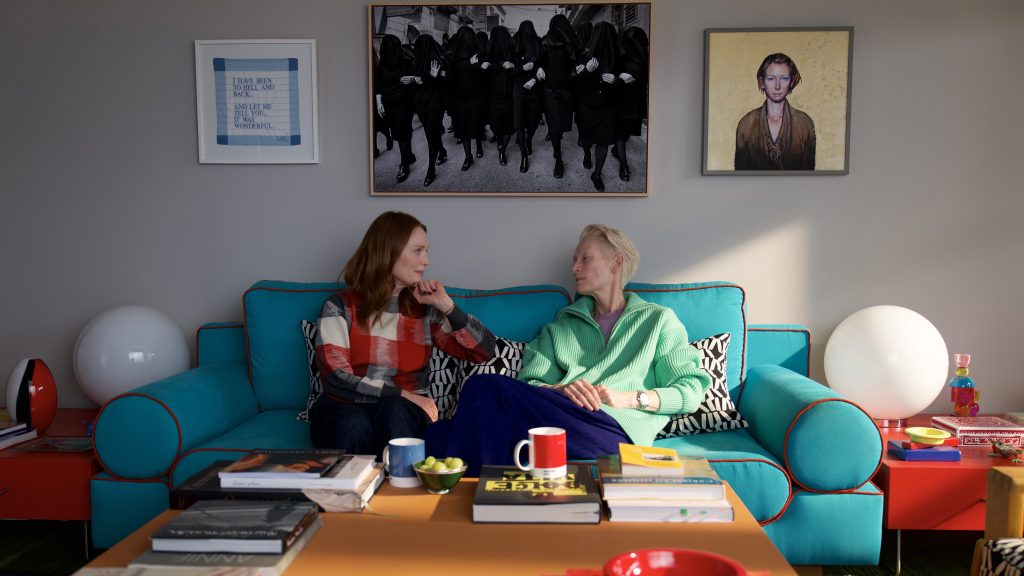
In his latest work, one of Spain’s most acclaimed directors, Pedro Almodovar, considers female friendships, motherhood, and euthanasia. This work is The Room Next Door, and stars Tilda Swinton and Julianne Moore. Based on the novel What Are You Going Through by Sigrid Nunez, Swinton’s Martha faces terminal cancer, and upon reuniting with her close friend from her past, Moore’s Ingrid, asks her to stay with her, in the room next door, as she makes a big decision about her future. Although compelling in what it wants to say about our relationship to the past, mothering, and what we ask of friends, the film too clearly comes off as an English language debut and feels quite disjointed, never fully allowing me to connect with the insightful message lying too deep within these underdeveloped women for me to ever access.
At a book signing for her latest novel, Ingrid is approached by an old friend, who tells her that her friend from youth, Martha, is battling cancer. As the two reconnect, Martha receives news that her cancer is terminal, and begins to reflect on her past and present relationships. As she thinks about her future, she requests Ingrid join her for a month away from the city, as she thinks about her future and her place in the world with an illness that has no cure.
To begin with the good here, the performances are stellar. It has come to be expected of Tilda Swinton and Julianne Moore, but the way they articulate without words the shared history between their two characters while also revealing the space that has grown between them in their years apart is doing a lot more than the script is allowing them. There are times the performances feel a bit forced and stunted, but I do think this is due to issues with the script and slightly uncanny dialogue, rather than the abilities of two of our greatest.
Aside from the story, there are some issues here withe the dialogue and overall script. I cannot imagine how difficult it would be to learn a second language, let alone write a story or script between two fictional characters, which is the journey that Almodovar tackled in making this film. As a native Spanish speaker, The Room Next Door is the first English language feature film that Almodovar has written and directed. While I applaud his abilities and his nerve to tackle such a beast, it unfortunately comes out feeling like it was written by someone who’s first language is not the one that is bring spoken in the film.
This is not to say that this should not be attempted, or has not been done successfully in the past. But for a story like The Room Next Door‘s that relies so heavily on dialogue between two women, often removed from the rest of society, for myself this would have benefitted from a few more drafts through a team with a variety of lingual knowledges. Slightly more believable dialogue here would have helped me to connect more to Ingrid and Martha, and feel like I know then as people, rather than struggling to suspend by disbelief each time they talk that they are not simply reciting a story.
Aside from the dialogue, I think there are also some issues here with how disjointed the story felt to me. Although a lot of his films are known for being quite vast and sending characters on a lot of different paths interacting with a lot of different characters, a lot of what happened seemed to occur without much pay off. Crucial scenes at the end involving law enforcement and different generations of characters felt like they were haphazardly thrown in at the last minute, with the credits rolling before I felt like I had any closure with regards to Ingrid, Martha, and their relationship.
If you are any part of the film loving community in Toronto, you quite possibly spent your last two months like I did: watching the films of Pedro Almodovar on the big screen at the TIFF lightbox. In celebration of his latest, the screenings that were part of this retrospective were often accompanied by introductions from Almodovar enthusiasts and film professionals, excited to share what they love about one of Spain’s most acclaimed living directors. I will admit that this retrospective introduced me to a lot more about this director than I knew before.
But I also acknowledge that having spent the past two months looking back at his best work, including Women on the Verge of a Nervous Breakdown, Volver, All About My Mother (my personal favourite), and Law of Desire, most definitely, and unfortunately, tainted my viewing of The Room Next Door. It is hard to look back at films that are already hailed as great works, on the big screen, and immediately go watch something that is clearly quite new to the director, with regards to the language of the film. But on a more positive hand, it shows how able Almodovar is as a filmmaker, and makes it so obvious why the bar is set so high for a director like him – because almost everything he has made thus far is great. So while The Room Next Door may not be his best work, there is still so much to be said about his decision to tackle his latest in the English language, looking back at what he has been able to accomplish up until now.
Although The Room Next Door was not one of my favourite films to start off the new year, I have to give credit to Pedro Almodovar for the performances of Tilda Swinton and Julianne Moore in his latest film. Although it is often held back by its dialogue and slightly disjointed narrative, Swinton and Moore’s performances and the overall themes of the story held me until the very end. After looking back at Almodovar’s work and getting to see him challenge himself in writing and directing a film in a language that his not his first, I am nothing but excited to see what he will do next.
The Room Next Door will be released in select theatres in Canada on January 10, 2024. Image courtesy of Mongrel Media.
 After Screening Cinema