
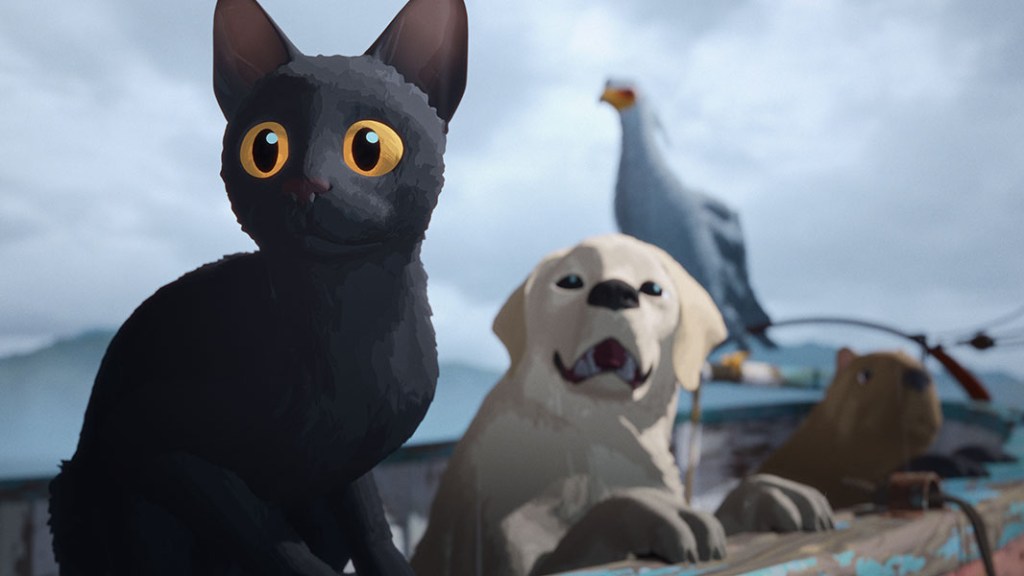
There seems to be a trend where big business cannot fathom viewers of art ability to relate to a piece of work unless they can directly see a mirror of themselves in it. Beyond stories mirroring our own experiences, as they often do and should, we have become a world of the live-action remake, turning animated favourites into films created almost shot for shot of the original, with one key difference being the existence of human actors, or ultra realistic animation. Flow flips this idea on its head, embracing a whimsical and truly animated look, asking viewers to relate to an animated cat’s story of survival after a great flood hits their home, with no dialogue throughout its 84 minute run time. One of the most touching films of 2024, this imaginative film breaths life into the animals we call our companions, as we root for their survival and see our own selves reflected in the characters, even though they are animated, non-talking animals.
As waters slowly rise in this human-free world, a solitary cat must find their way to safety, not knowing when the rising water will end. Being alone, as an animal known to dislike the water, the cat slowly forms a group with other solitary creatures, including a dog, a capybara, a monkey, and a bird, who work in tandem with each species’ strengths and weaknesses to survive together as the waters continue to rise. Told dialogue free, the animals communicate in ways we as human observers would expect them to, through body language, facial expressions, and their own unique animal sounds.
The animation style here can’t go unnoticed. It does strikingly look like something out of a video game cut scene when the film starts, and for myself, took some getting used to. But quickly I found comfort in this more simple style of animation, reflecting on the story told in this specific medium. It reminded me of Puss in Boots: The Last Wish, which pushed the boundaries of what animation could look like within the big studio setting. The care for the art is obvious here, and is especially beautiful and noticeable in sequences with water, which a film about a flood has a lot of.
In terms of the simple story, there is a beautiful reminder here throughout of the importance of having an appreciation for what we have, and how quickly our circumstances can change. As the world changes around us, it is up to us, like the cat, to adapt to these changes. But in the moments in between, we must also always be grateful for what we have. As the cat finds their way in this new world, with a new group of animals that quickly become all they have left, it is the moments in between, when they all work together to get food and shelter, appreciating the moments in between all the change, that really hit home the hardest. The care we can have for those we only just met, because of circumstances out of our control that led us together.
While watching this found family, whether it is their big moments of survival or their little sweet moments in between, there is also such a unique use of commonly understood animal behaviours here that are so cute to watch work in tandem. The cat is a typical cat, who loves solitude and is quite moody, while the golden retriever will do anything for attention and a game of fetch. The capybara has only food and sleep on their mind, while the bird has become the leader and protector of the pack. It is a fun movie to watch with animal lovers, especially those with a pet at home, to recognize decisions in these animal characters that we have come to expect having domestic pets at home.
On top of this sweet use of animal behaviours, there is also a deeper use of these animals, and their lack of dialogue, to mirror our own human interactions and survival instincts. It could be easy to watch a film about humans trying to survive a flood and predict how we would behave. But on a much deeper level, the use of animals here helps us to recognize how much our own instincts are so animal, with the added fun bonus of seeing which animal we feel we relate to the most. How do our instincts to survive, above all, change or look after we find a group of others in the same survival mode, where we all have nothing left but each other.
In a world that is quickly becoming less interested in taking animated films seriously with every passing day, Flow is one to add to the watchlist of anyone looking for trust to be given back to audiences. Trust that, even though the characters might not look exactly like them – or even be of the same species – they will find something to relate to. Trust that the message of the power of a found family and appreciating what we have won’t go over their heads because the film is animated. Trust that the story will be taken seriously even though it is told through a medium often reserved for children’s media. Because Flow is something special, and every cat, dog, and animal lover will be crying for the survival of every animated creature on screen, no matter what their age.
Flow (2024) is now playing in select theatres in Canada. Image courtesy of TIFF.
 After Screening Cinema