
Can I Get A Witness? is a fascinating film. Director and writer Ann Marie Fleming depicts a future world, not so far off from ours, where climate change has ended and global poverty has been eradicated. This is thanks to a global agreement that states that places restrictions on electricity use, travel, and population, and contains a major rule; that everyone must end their lives at 50, to preserve precious resources for the younger generation. While the film is ambitious in its exploration of a fictional future and a end to climate change, it unfortunately falters in its execution, especially in its focus. What could have been a beautiful mother-daughter story and exploration of a coming-of-age in an unusual future world turned into something much less emotionally-compelling and thought-provoking as it could have been.
I was interested to see Can I Get A Witness? as my curiosity was piqued about a world where its people have found a solution to climate change and global inequality. The film follows Kiah, who knows nothing of the world we know, who begins to work as an artist for EOL ceremonies. These are End Of Life ceremonies, which take place when people turn 50, as the world has mandated a rule that states that everyone, upon reaching this age, must end their lives. Kiah struggles with her job, drawing recreations of these people’s last moments alive, facing new relationships and a future without her mother, who will soon celebrate her own EOL ceremony.
The film begins with two words on screen. “A fable”. A story from which we are to take a lesson from. In this case, the lesson is one about collective action. It is about the sacrifices that must be made in order to make the planet one that is habitable for generations to come. No, I don’t think this film is *actually* saying that killing people at the age of 50 is the right decision. Rather, it is a reminder that the small things we are doing right now that seem so important are just that. Small. It forces us to face the truth that more needs to be done, and now, in order to avoid a future like this one, or one where our planet is ravaged and uninhabitable. A reminder that sacrifices we are currently making most likely aren’t big enough, and how much it will take a collective force to make a change.
Even though the ideas in this film are genuinely unique and inspired, I can’t help but think about how much better it could have been if the script were more focussed from the start. Sandra Oh plays Kiah’s mother, who will soon experience the end of her life. But this major part of the story, though revealed quite early on, weirdly takes a back seat for most of the film, instead of becoming what I assumed would be the main emotional arc of the film. Instead, we see many scenes of Kiah and her new co-worker, Daniel, becoming closer and she struggles to understand this mandated rule she is working to enforce, intercut with scenes of Sandra Oh, alone, preparing for her end of life. While this may work in theory, the jarring distance between Kiah and her mother throughout the film not only slow the pacing, as the two stories feel very disjoined, but also impacts the final emotional beat of the film as Kiah and her mother share a tender moment. This moment is special, but unfortunately comes with too little build up before hand, trying to make me care for a relationship that I barely saw developed on screen in the time before.
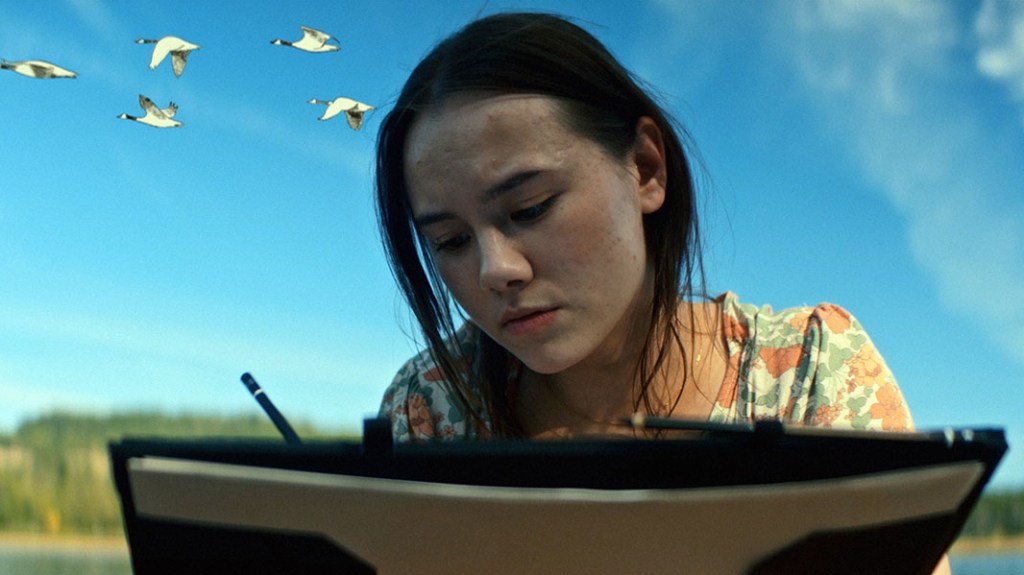
Aside from the story, the film uniquely uses animation to infuse a sense of life and youthfulness into the film. This aspect works in a fresh way to really drive home the fact of how young the people like Kiah and Daniel are. The people who must deal with the death, and with the aftermath, they are still just kids. This animation breathes life into the shots before people reach their end of life, absent as their life is taken away. It is a cool use of animation, but again feels underdeveloped and under-utilized, not appearing for long stretches of the film, but not adding enough to the scenes that they are present in to make us feel like we are missing anything in the scenes from which they are absent.
Despite not having much to work with in terms of the script, Kiera Jang as Kiah and Sandra Oh as her mother breathe life into this film. The ever brilliant Sandra Oh beautifully supports Jang’s performance of a teen trying to understand the world she is living in. I was so sad to have not seen more of them together, playing such a believable mother-daughter pair filled with so much real respect and understanding.
I wish I liked Can I Get A Witness? more. But it’s unfocussed script and emphasis on the wrong relationships makes its unique take on a possible future world and its warnings come off as half-baked. Sandra Oh and Kiera Jang pull this film together, and do what they can with the materials they had, but it is never enough to fully engulf me in this possible future world.
Can I Get A Witness? was screened at the 2024 Toronto International Film Festival. Image courtesy of TIFF.
 After Screening Cinema