

How do we live when we know that each moment could be our last? How does our outlook on life change when our future plans are forcibly changed, or possibly no longer possibilities at all? Almut and Tobias face these questions in director John Crowley’s We Live In Time, following a couple throughout their lives in a non-linear narrative, as Almut faces a life-changing diagnosis. Starring Oscar nominated actors Florence Pugh and Andrew Garfield, We Live In Time takes the story we have all heard before, of a couple who face a devastating change in their life plans, and transforms it into something so unlike anything seen on screen. Paired with palpable chemistry between the leads, present in every scene of this film, and a wonderful screenplay, We Live In Time had me laughing out loud and holding back tears.
Right off the bat, we are thrown into the deep end of Almut (Florence Pugh) and Tobias’ (Andrew Garfield) relationship, told alongside the couple about the return of Almut’s cancer. From here, we jump back in time, following the inception of Almut and Tobias’ relationship in a chance encounter that is anything but ordinary. The film continues in this fashion for rest of the runtime, cutting between three timelines, of the couple in the beginning stages of their relationship, the couple facing the news of the return of the cancer, and Almut going through treatment with Tobias by her side, as she faces what comes next.
Not only does this non-linear take on the what could have been a very rehashed tale make it’s simple story wildly entertaining, it also works to hone in on the themes of how we spend our time, and make the most of what we have left. Almut is competitive, she always has been, and is desperate to leave her mark on the world and for her daughter once she grapples with the fact that she may not be around for as long as she thought. For the couple, they face a world where Almut’s treatments could make what may be her last 12 months on Earth entirely passive. How can these final moments be spent as actively as they can, without jeopardizing Almut’s treatment? But in its constant flashbacks and jumps forwards, screenwriter Nick Payne reminds us that although it often feels we must do something active and big to define us and leave our “mark”, there is so much more to who we are. Payne’s screenplay highlights all of the things that seemed small in the past and present of the couple’s relationship, that in the end come together to form an amalgamation of all the meaning in their lives. It reminds us that we do not live to make a mark, nor do we live to do *one* great thing. Rather, we live in a constantly moving and ever uncontrollable timeline, time passing-by, and we must choose to make the better of each moment we are given.
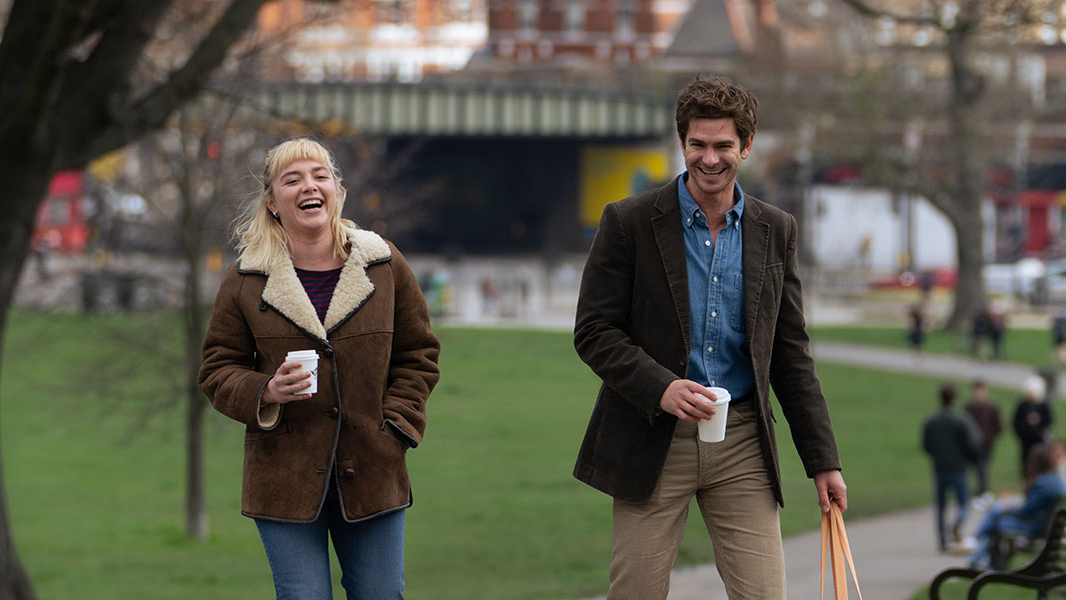
Small moments in the garden, trying new recipes, running through the park, and playing tea time with our children. Big moments like professing our love, great accomplishments after hard work pays off, and diagnoses that change our lives. All of these moments influence our present, but with a future so uncertain, Payne reminds us that we must avoid ever mourning what we have yet to lose. Avoid mourning the loss of children we do not yet have, the end of a relationship that is just beginning, or the end of a life that is still being lived. We must live in the time we have now and make meaning every day in the small things. This is so brilliantly portrayed by the jumping timeline, producing what could be seen as a 2-hour montage of what makes Almut (and Tobias) who they are, placing meaning in their lives outside of a single accolade or diagnosis.
It goes without saying that Florence Pugh and Andrew Garfield are the hearts of this film. Throughout, they prove why they are some of this generation’s best. There is not a scene in which the two are not present, and the chemistry between the two is unforgettable. On top of this, the film is surprisingly hilarious, with dialogue that is so genuine and realistic that it feels like you are sitting at home listening to two of your best friends. And of course, these stellar performances cannot be talked about without mentioning director John Crowley, who it able to inspire and retrieve these amazing and genuine performances that feel so real. The editing works wonders to never feel like it is pushing two hours with a story as simple as this one, making the pacing feel very natural despite the constant time jumps that work so well in all aspects of the film.
At the end of the film’s screening, the women’s washroom was filled with subtle sobs and sounds of discreet nose-blowing. But leaving the theatre, despite its sombre ending and subject matter, I could not help but feel so much hope and calm every time I continued to think about the film. It felt like a warm hug, never dwelling on Almut’s diagnosis, or what we inevitably felt as an audience what was coming. It instead acted as a reminder that your life does not need to be defined by your final months, or your final big event. Rather, a person and their life’s meaning is made up of an amalgamation of all they have done, and all who they were; all the small things that lead up to the big things that make up our short time on this Earth. We Live In Time is a genuine crowd-pleaser, and we are all so lucky to get to spend 2 of our hours of time in this life alongside Almut and Tobias.
We Live In Time was screened at the 2024 Toronto International Film Festival and will release in theatres in Canada on October 11, 2024. Image courtesy of TIFF.
 After Screening Cinema