
I am a simple girl. If I see Adèle Exarchopoulos in the cast, I will watch. This worked out in my favour last year introducing me to Passages, and got me interested in her latest work, Planet B, directed by Aude Léa Rapin. The film is a science-fiction thriller film, and resembles a long episode of Black Mirror, following two parallel stories that slowly collide, in a future world not unlike one which seems entirely possible for us. Despite its shortcomings in the plot and overall focus, the performances are enough to keep viewers entertained throughout, so long as they don’t think too much about the attempts at a message behind the film once they leave the theatre.
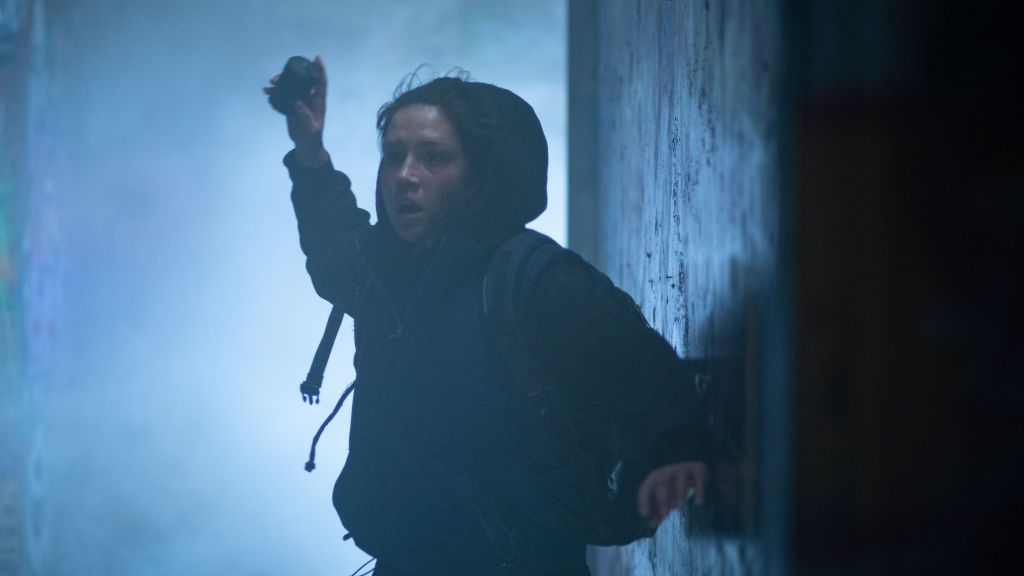
The two stories the film tells are quite simple, that come together in a unique manner all relating back to this mysterious “planet B”. The first is of Exarchopoulos’ Julia, a climate activist living in France who wakes up in what seems like another world, “planet B”, after one of her climate protest actions goes wrong. The other tells the story of Souhelia Yacoub’s Nour, an immigrant living in France who is struggling for money to find a way to legally stay in the country. What follows is a story of Julia who, along with other climate activists, tries to escape planet B without turning on her co-workers still working on the cause back home, while Nour is slowly introduced to the truth behind planet B, and those trapped inside.
I recently listened to the podcast “Burn Wild”, which ponders eco-terrorism, and the use of the word “terrorism” to describe these extreme actions that occur in the name of the planet’s future. Without delving into the in’s and outs of their arguments, I read the synopsis of Planet B, a film that follows an activist after they are part of a violent climate protest, and was excited to see more. The beginning gave me what I expected, a glimpse into the world of passionate people doing what they believed was right in the name of their cause. Similarly, Nour’s story as an immigrant, who’s “QR code” will expire in a few days unless she comes up with a large sum of money, leaving her unable to call France a home after that, and I was interested to see how these two stories would overlap.
But as the story developed, there would be simple remarks made that never went any deeper, that introduced so many threads that I wish were touched on with any amount of intrigue. Comments that touched on arguments like the over-policing of protests, compared to those whose crimes could be seen as much worse, and the treatment towards immigrants, given less opportunities simply because of the location of their births. These comments throughout kept reminding me of how much more the story and film could be doing. Even its title, Planet B, a term commonly used to remind people that there is no second chance and so we must take care of our Earth, is never really used to its full potential, instead turning their planet B into an exploration (and still shallow) of a possible future look at incarceration. Actually challenging viewers to question how these topics, like climate activism, eco-terrorism, over-policing, and the treatment of immigrants are prevalent in their lives now, urging them to see how this future is nothing but possible if we continue down this road. Instead, what is left is a half-baked Black Mirror episode, that focusses more on trying to make Julia’s escape from planet B thrilling with the help of Nour, instead of anything else.
With all of this to say, Adèle Exarchopoulos still shines with the little she is given to work with. Her passion for the cause, the determined manner with which she takes charge in planet B, all come across as genuinely thoughtful. Souhelia Yacoub is no different, working to give her story a much more grounded feeling than the story ever does, at her best in small moments alone in France, relaying the loneliness that a life like hers must come with.
Those looking for a sci-fi epic that poses thoughtful questions about climate-activism and the state of immigration might be better off looking for a film elsewhere. But for fans of Black Mirror, as well as Adèle Exarchopoulos, Planet B is a good choice film. Although it does not prod as deep into any questions about the topics describes as it has the potential to do, it is still an entertaining look into a possible future world, that is unfortunately not so far from the one we call home today.
Planet B was screened at the 81st Venice International Film Festival. Image courtesy of Le Plante – France.
 After Screening Cinema