

The Japanese Canadian identity is one that carries a lot of historical weight. An identity so faintly discussed in Canadian history classes, often reduced to a mere sentence by history teachers throughout the 5 months of mandatory history lessons in high school. Or, in my case, an identity only discussed because there were two of us in the class who shared this Japanese Canadian heritage. One of the latest features in Canadian cinema also explores this identity, but rather than becoming a history lesson or historic retelling instead explores the Japanese Canadian identity alongside themes of grief, loss, marriage, and family. This is Meredith Hama-Brown’s Seagrass, which follows a Japanese Canadian mother, Judith, as she grieves the loss of her own mother, while working through issues in her own marriage with a white man, alongside her children at a retreat. What follows is a 2 hour exploration into Judith’s, own relationship with her mother, her husband, and her children, as she struggles with her own identity as a Japanese Canadian woman.
Seagrass follows Judith, at a retreat with her husband and two children as her and her husband work through their marital problems. As their situation at the retreat unfolds, Judith begins to see how her problems in her own home seem to stem from her own background, and following the death of her mother, and what she feels is her only connection to her Japanese heritage, she struggles to find her own place in her marriage and the world.
As a person with quite a diverse background (Japanese, Trinidadian, Irish, Portuguese), I grew up, and still to this day, hear “no… but where are you REALLY from?” far too often when my response to their question of where I call home is simply “Toronto, Canada”. After one small line early on in Hama-Brown’s Seagrass, when one Japanese Canadian character asks Judith about her parent’s experience with the internment camps, I found myself quite deeply reflecting on my own identity and my relationship to my home and birthplace of Canada. Sure, this is a story of a couple slowly breaking apart, with a divorce in the horizon of every shot they occupy. But at the root of this unhappiness is Judith’s own struggle with her Japanese Canadian heritage, as she begins to question how she can be a mother and a wife when she doesn’t feel she truly knows herself as a singular person of Japanese descent, born and raised in Canada.
For a brief historical interlude (read more here): in 1942 the Canadian government forced Japanese Canadian families to leave their homes without their belongings and live in camps in small towns for years, despite the fact that many of them were born in Canada. This came in the aftermath of Japan’s attack on Pearl Harbour, as many non-Japanese Canadians viewed anyone of Japanese descent as a threat, especially on the West Coast. In 1945, these families were given the choice to move back to Japan (a country where many had never stepped foot), or to move elsewhere in Canada, or who returned to discover their homes and belongings were sold by the government.
Japanese Canadians, or at least the ones I know, don’t like to talk about the war. There seems to be some collective belief that, since Canada hated them in the 1940s for being Japanese, they would continue their lives post-war being as removed from Japan and its culture as possible. They thought they were “too Japanese”, despite many of them never having stepped foot in Japan. They wanted to become as “Canadian” as they could, and leave everything that they associated with Japan behind.
I grew up knowing vaguely about the internment camp that my late grandfather spent part of his early childhood in with his family during World War 2. But since my grandfather – and similarly almost his whole generation – didn’t talk to his children about his history, my mom didn’t have much to pass down to me and my brother. We learned a lot together. Even though I was raised quite aware of my mom’s childhood and her experience growing up Japanese in Toronto, it wasn’t until we went to Japan for the first time last year, when I was 23, that I truly saw another side of her past and her history with her identity that even she was unaware of. Walking into restaurants, where a certain smell or the curtains hanging over an open doorway would spark nostalgia and memories in her that we never heard before, spilling out over dinners as she shared stories of her aunt’s homes that has a similar smell, or memories of running between bedrooms with only a curtain separating them. Certain foods we tried, or bowls we ate from, or textures and weights of air surrounding us in temples as incense burned, the tiniest of stories shared by my mom, with new little slivers of her revealed to myself, my brother, and my dad. Memories my mom held so deeply, which she never associated with “being Japanese” but rather just “being a kid”.
Now for my generation, born in the new millennium, this “fully assimilated Japanese” is all we know. We eat KFC and pasta casserole at family gatherings. None of us speak any Japanese. We attend family gatherings in May to remember those who have passed but we don’t even know the real name or origin of this celebration (and it seems that no one else has heard of it either). Most of our aunts and uncles who had memories of the internment camps have passed, and those we did know either never talked about it, or we were too young to know to ask.
There is a stunning scene in Judith and her husband’s room where Judith breaks down over grief for her late mother. She recalls that she doesn’t know any of her mom’s recipes. She feels guilt that she never even thought to ask her for them, and feels confused as to why her mother didn’t offer them without Judith needing to ask her to share them. I see my mom in Judith. Her, like so many other children of adults who were interned, never knew how much their parents were trying to push away their pasts to assimilate into an imagined Canadian identity to try to keep their families safe. She didn’t have the internet and social media to hear other people’s stories and to find other people like her, nor representation in movies that ever portrayed people like her in complex stories like Judith’s in Seagrass. She didn’t ask these questions to her father because she simply didn’t know to ask them. Now, my mom and I tackle these complexities of our identity together. As a family, we talk about what makes us different, but also how we are all the same. We cook together and share stories, passing new learnings between each other so that one day, hopefully, the answers to the questions I never thought to ask will live in my daily routine and the way I learned to do things from my loved ones.
The Japanese Canadian identity such a unique one, and one built on so much history that is glazed over in 10th grade history classes across the country. I am lucky that growing up I can’t say I ever felt “left out” because I didn’t see myself being represented in media. But watching Seagrass, where I see so much of my mother and myself in the characters present, I leave the theatre feeling, “oh, maybe THIS is how I should have been feeling all my life”, seeing my family history given a complex voice on the big screen.
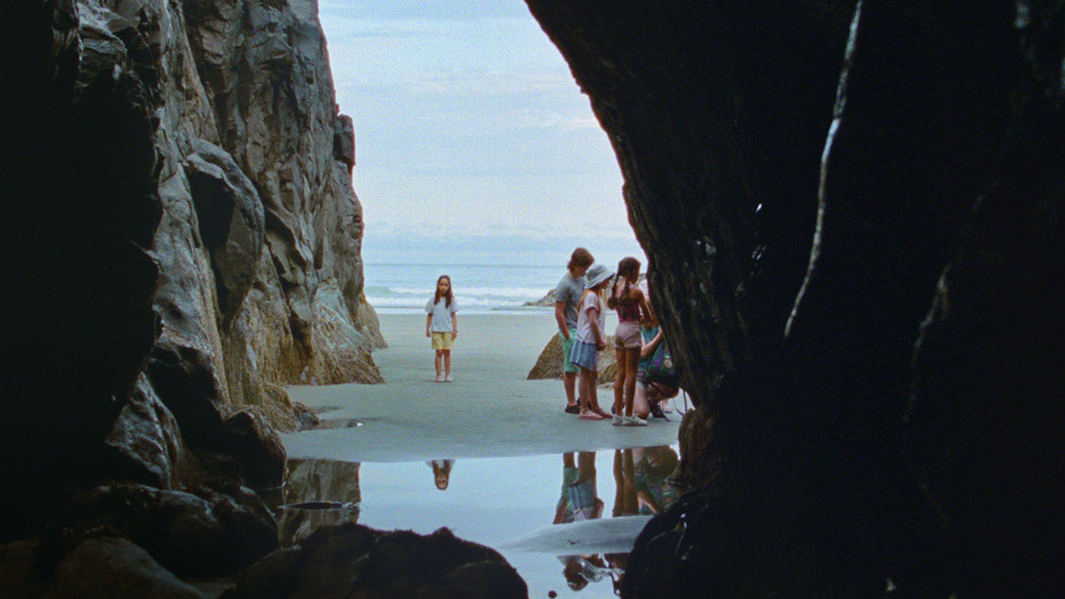
Seagrass (2024) is showing in select theatres in Canada. Image courtesy of TIFF.
 After Screening Cinema