
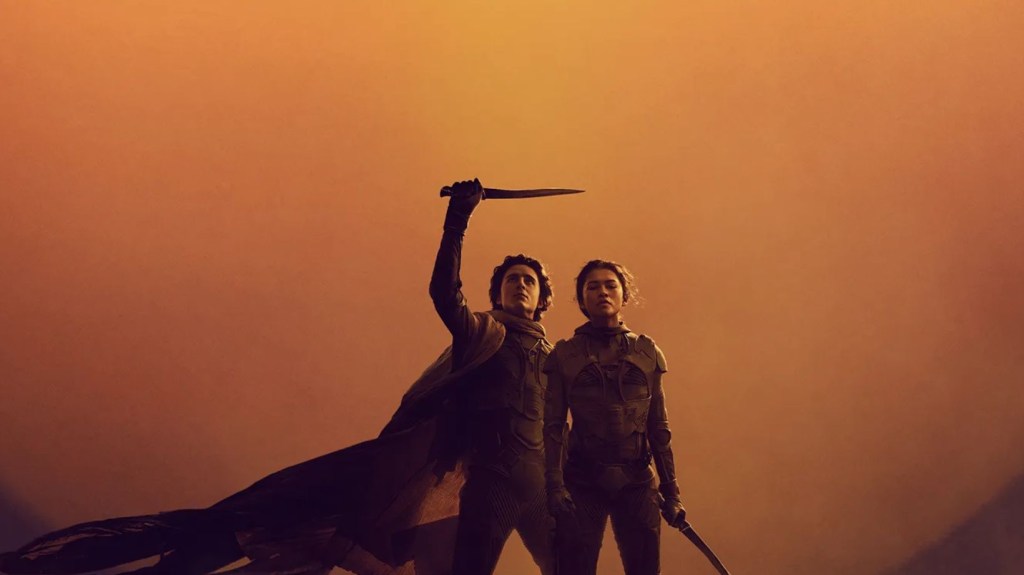
Dune: Part Two is a force. More worlds. More psychotic Harkonnens. More sandworms. More Zendaya. Its sheer size and technical achievements are something to be astounded by, not to mention its stellar performances all around from its all-star cast. As director Denis Villeneuve has intended from the start, the film is not a sequel. Rather, it is a true “part two”, continuing almost right where Part One left off. House Atreides has fallen, following an attack by House Harkonnen, backed by the Emperor himself. Unbeknownst to them, Paul Atreides (Timothée Chalamet) and his mother Lady Jessica (Rebecca Ferguson) have escaped to the desert of Arrakis, taken in by Stilgar’s (Javier Bardem) Fremen troop, native to Arrakis and knowledgeable of the deathly desert, including member Chani (Zendaya), the young woman from Paul’s dreams. Picking up in Part Two, audiences are led through the first minutes of the film with narration from princess Irulan (Florence Pugh), the Emperor’s (Christopher Walken) daughter, as she journals that she believes Paul Atreides may still be alive. Mirroring the first film’s opening narration from Zendaya’s Chani from the start, this film is anything but equal to that of its predecessor.
This new opening, one leading the viewer into the story from an outsider perspective, that of the rich princess Irulan, rather than that of Chani, born and raised Fremen on Arrakis, sets off the new perspective that this film, and Paul himself, will come to relay. The Paul we know from Part One had his father (Oscar Isaac) to guide him. As Part Two develops he is on his own, to decide who Paul Atreides will become, and whether his dreams where he sees death and destruction caused by his actions will become reality. Part Two opens with the voice of an outsider, in her outside world, as an outsider himself, Paul Atreides, will come to fight, over the 155 minute runtime, to decide how his story will be told, and whether his dreams will become the future.
Following this narrated introduction, the first section of Part Two deals largely in building upon many of the Fremen characters we so barely got to know in Part One. Paul trains to become Fremen as his relationship with Chani grows, while Lady Jessica fulfills her own agenda as part of the Bene Gesserit, a group of women focussed on acquiring power and influence to direct humanity to a certain future. She becomes a spiritual leader to the Fremen, and begins to echo and indulge them in their beliefs that Paul is the Lisan al-Gaib, the messiah prophesied to come from another world to save them.
This first section is highly reminiscent of Part One, which truly was large in scale, but still quite small in terms of the entire world built during in-film discussions, largely remaining on Arrakis and with the same characters for large amounts of time. Part Two gives the Fremen more personality that Part One did, while also highlighting the very relevant topics of religion and its use to either give people hope, or to control the very believers. Beginning in this section, we see begin to see Chani’s opinion on these prophesies and saviours, given a voice that Part One‘s slow-motion dream sequences of her never did. She believes that the promise of a messiah and what the Bene Gesserit preach is used to oppress the Fremen and all those who believe, to keep them waiting for a saviour that will never come, preventing them from saving themselves, or to be lead by one of their own.
Following this time on Arrakis, we are then taken out of Arrakis and onto new worlds for a large portion of time. We enter the baron Harkonnen’s homeworld, where we meet Feyd-Rautha (Austin Butler), the Baron’s psychotic killing machine of a nephew, who is seduced by another Bene Gesserit, Margot (Lea Seydoux), to take over Arrakis and battle Paul Atreides. We then return to the Emperor’s homeworld, and again meet princes Irulan, the Emperor, and more Bene Gesserit, who all have their own agendas in the coming future of Paul Atreides and Arrakis as a whole. As Part Two expands on Part One, the whole universe of Dune grows with it, giving us as viewers tasteful glimpses into the enormity of the fantastical world that has been built that only has the potential to keep growing.
There is of course a final return to Arrakis, where all personalities, new and old, meet up in an epic culmination of all that is spice, religion, and power. This culmination is epic, and one that is breathtaking in both its scale and its visuals. Throughout the entire film, Villeneuve’s flair and direction are purposeful and present. Despite this being a big budget film filled with CGI and visual effects, Villeneuve’s personality is always present, and there is a clear love behind the camera of the worlds built and the characters captured that is so beautifully relayed in the stunning extreme long shots and the intimate close ups between lovers, enemies, and worlds. Part One is instantly recognizable on Arrakis, but as the film moves away from the Arrakis we know and into new territories of this world and into brand new ones, they are all captured so distinctly, relaying just the emotions intended to. The film is able to switch seamlessly from a huge and sprawling battle scene one second to a close and intimate scene the next without fail, leading viewers emotionally not only through the story, but through the visuals presented. Although the very universe of Dune grows with every scene of this film, the smaller and more intimate scenes are still just as impactful, driving home the hope, love, and despair at the heart of the film.
Similarly, not one performance over shadows another, or comes as a let down from expectations or past performances, but rather, all players perfectly find a stunning balance between these universe-trotting-sandworm-riding character’s they are playing, and the more subtle intentions in their hearts and minds. While all of the performances shine, Zendaya does stand out in this one, beautifully toying the line between being an apprehensive first lover and a strong, powerful fighter standing alone against a frightening oppressor, and the very man she loves.
There are still some very minor let downs in the film, despite it being one of the best of the genre in recent memory. Some character motivations in the third act seem slightly underdeveloped, especially the big shift in motivation involving the alleged messiah himself. This is an area I would have liked to have dove a bit deeper into which, sure, is very much built up to throughout the entirety of the film, but in the moment seems to be reduced to quite a small conversation between Paul and Lady Jessica before the epic finale.
Further, while this is literal Part Two, and does a stellar job at growing just the right amount to keep viewers wanting to see more, there is almost too much left open by the end, in preparation for what we can only assume to be Villeneuve’s Dune: Messiah, not yet confirmed but quite obviously coming. These open ends totally work, and yes, the film does still see through its major arcs, but many character’s are left once again waiting to be fully realized. Paul, Lady Jessica, and Chani’s journeys, arguably the most important, are fantastic, and make me only excited for more. But other character journeys are much less satisfying, like Pugh’s princess Irulan, who receives the same treatment that Chani does in Part One; present enough to introduce her and so that viewers know she will be important in the future, but never present enough to create any kind of complexity in a story where that very future is left to be fully realized in the next (hopefully) film. While this can be slightly annoying by the end, these set-ups still definitely work in the bigger picture of the trilogy, and to excite me for what is to come. I am so glad that both this film and Part One took the time they both needed to so beautifully and articulately build this world, to create what will most likely come to be one of the greatest trilogies in film history.
Despite my very minor grievances with the third act and its preparation for the third (and final) alleged part of Denis Villeneuve’s Dune trilogy, Dune: Part Two is a force to be reckoned with. Its breathtaking visuals, the personality in its direction, stunning performances from its all-star cast, and relevant themes like the spread of religion, oppression, and power treated with such humanity and care are just the beginning of what make this film so groundbreaking. It grows what Part One set up in almost every scene, while still staying true to the family and coming-of-age-and-into-power story that it truly is. Zendaya’s Chani and her story of the Fremen will only continue to inspire the next generation of science-fiction and movie lovers to stand up to save their own, when the “voice from the outside world” comes into frightening yet bold command. The final shot leaves me left with nothing but pure exhilaration and anticipation for what will come next in the inevitable final instalment of Villeneuve’s astounding Dune trilogy. Because how can you not follow this one up?
Dune: Part Two will be released in theatres across Canada on March 1, 2024.
 After Screening Cinema