
To be a woman is to be subjected to the health care system in a man-centric world. A topic remaining scarcely talked about on the big screen, Canadian director Molly McGlynn opens up about her own experience with the reproductive condition MRKH syndrome in her latest feature, Fitting In. Written and directed by McGlynn, the semi-autobiographical film follows Lindy, played by Maddie Ziegler, as she learns she has Mayer-Rokitansky-Küster-Hauser (MRKH) Syndrome, upending her plans to have sex and sending her on a journey of discovering her own sexuality and body in a world where her diagnosis is anything but normal. Using the fictional world of film to open up new discussions on these typically hidden parts of growing up in our man-centred world, with a strong dramatic performance from Ziegler, Fitting In is a new Canadian coming of age story that will be be important to so many young girls on their own transitional journeys.
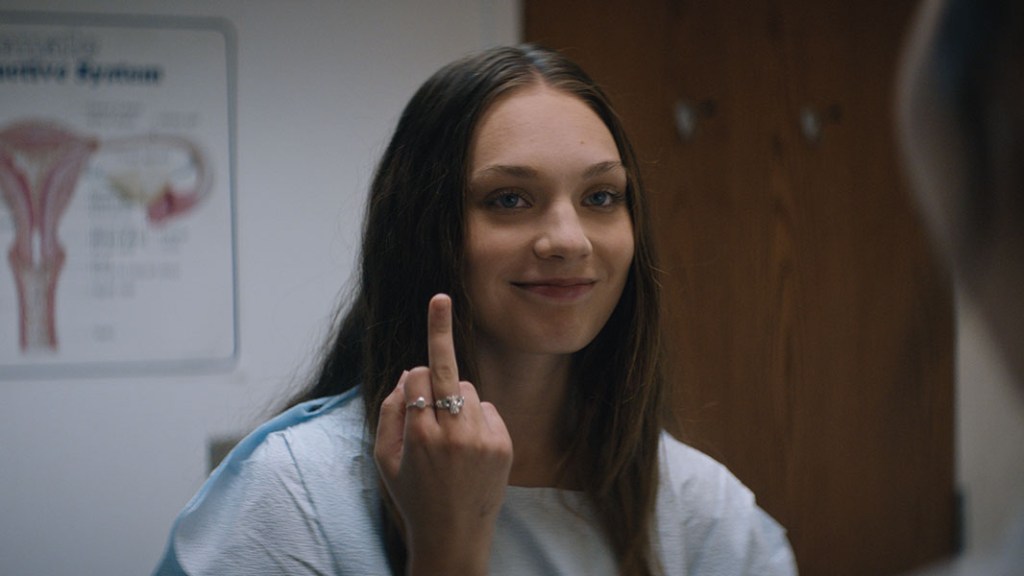
Maddie Ziegler (The Fallout) plays Lindy, a 16 year old high school student at a new school, in a new town, hoping to soon have sex with her new boyfriend. Following her first visit to the gynecologist, Lindy is diagnosed with Mayer-Rokitansky-Küster-Hauser (MRKH) Syndrome, causing her to be born without a uterus or vaginal canal. Encouraged by the all-male slate of doctors she is promptly whisked through to “fix” her problem and begin what one female doctor calls a “vagina bootcamp”, Lindy begins her own journey to discover what sex and intimacy mean to her. Alongside her single mother Rita, played by Canada’s own Emily Hampshire (Schitt’s Creek), and new friends, Lindy is forced to overcome judgement from outsiders as she grapples with her own self-image and sexuality, getting to know her diagnosis and her own body.
Written and directed by Molly McGlynn, Fitting In is loosely based on McGlynn’s own experience growing up and being diagnosed with MRKH syndrome. Her tragi-comedy is a breath of fresh air in the coming-of-age genre, posing tough questions to viewers about the state of the women’s healthcare system when it is in the hands of men, as well as the state of the world when anything but “normal” (hetero, syndrome-absent, etc.) sex has become a taboo topic of discussion. McGlynn vulnerably displays her own experiences on the big screen, to begin new discussions on MRKH syndrome, specifically, and the place of women’s sexual health and pleasure in society, in general.
Given the semi-autobiographical nature of the film, star Maddie Ziegler has some big shoes to fill, and overall succeeds. While starting off kind of awkwardly, her performance quickly ramps up as the dramatic tones of the film take over. The first few scenes with Lindy, as she makes small walk with her friends and flirts with her boyfriend, feel quite forced, but it is not too long after that Ziegler has audiences watching through teary eyes as they live through her the life of Lindy, the young girl vs. the man-made world of healthcare. Emily Hampshire adds with her quirky take on Lindy’s mom, Rita, whose chemistry with Ziegler feels less than authentic but still meaningful. She shines in the scenes sprinkled with comedy, while still pulling out an emotional monologue near the end of the film, motivating Lindy forward in the final stretch of the film.
Aside from the film bringing much needed attention to the state of the healthcare system for young women and MRKH syndrome, the screenplay does feel a little underwhelming. The third act is stuffed with far too many attempts at a personal revelation and plot points trying to tie everything together, and comes off a little corny by the time we finally get to the actual end. What it has to say about female pleasure is important and well thought out, but after the whirlwind that these final 30 minutes become, it feels like this final chapter couldn’t have come any sooner. With this jam packed final half hour, there are still many precursor scenes that sometimes come off as quite dull, as a means to attempt to make important discussions more casual, or to introduce yet another way in an already packed screenplay that Lindy discovers her own body and relationship with it – from her boyfriend, to her best friend, to her new friend, and to the cute boy from the burger shop, not to mention her mother’s own personal journey following a mastectomy. It would have been nice to see more of a focus in this aspect, more deeply drawing out a few less plot points rather than fumbling far too quickly through a lot of them.
Being a teenage girl is “bloody hell” (the original and arguably more fun title of this film). It only gets hards with a diagnosis at 16 of a rare reproductive condition, and writer/director Molly McGlynn explores her own experience with MRKH syndrome in her new film, Fitting In. From male doctors convincing her she needs to make herself more “normal”, to teenage hook-ups that look completely different from what she expected now that she has been diagnosed, Maddie Ziegler plays Lindy, the young girl trying to make her way through being 16. Off to a rocky start, and with some questionable screenplay decisions, the film ultimately lands on its feet, and succeeds in opening new doors to conversations still considered taboo to many, about the state of women’s healthcare and the place of women’s pleasure in sex and the world.
Fitting In (2024) is out now in select theatres in Canada. Image courtesy of TIFF.
 After Screening Cinema