
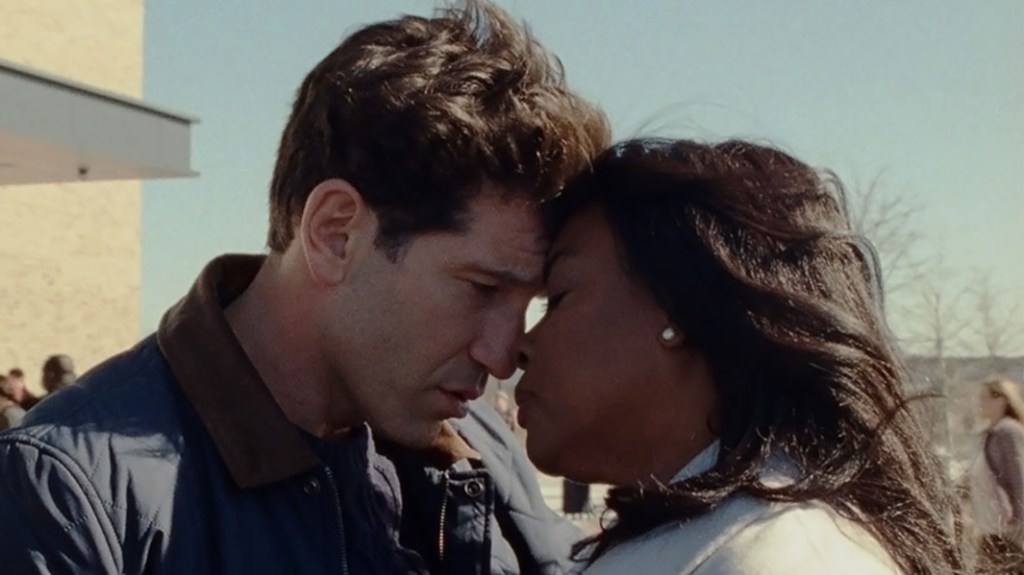
Acclaimed director Ava DuVernay brings her latest feature to the big screen with Origin, her unique take on the 2020 nonfiction book by the American journalist Isabel Wilkerson titled Caste: The Origins of our Discontents. While puzzling to many how DuVernay would bring this nonfiction book to the big screen in a narrative format, she once again proves why she is known as one of the modern greats, finding a narrative throughline in the story of the creation of the novel, adding a dramatic tone to the novel more suited for a narrative story. With a stellar central performance in the film by Aunjanue Ellis as the author of the book, as well as an insightful introduction to Wilkerson’s thesis and main points, Origin is sure to be recognized as a success as a narrative adaptation of an important nonfiction book, bringing its arguments to so many new listeners.
Origin tells the story of author Isabel Wilkerson, on a mission to find the topic of her newest book. In her journey searching for the thesis of her book, which would become the 2020 non-fiction book Caste: The Origins of our Discontents, DuVernay follows Wilkerson in the aftermath of familial tragedy as she travels around the world to research caste and its existence and impacts throughout history. Through a narrative lens, the film uses Wilkerson’s own true story behind the making of her 2020 acclaimed book to show how love inspires us and carries us forward, while also being a tool used throughout history to perpetuate the system of dividing society into hereditary classes.
Aunjanue Ellis carries the film through to its ending, playing the author and central figure in the film Isabel Wilkerson. Her performance is subtle, but imbues a deep understanding of Wilkerson’s pain and knowledge, capturing the true story and heartache at the core of Wilkerson’s experience writing her book.
There is a unique yet risky creative decision here that readers of the book will notice immediately. While Isabel Wilkerson’s book Caste: The Origins of Our Discontent is a non-fiction book, DuVeray’s film is told through a dramatic narrative. While many would assume that the novel would be adapted documentary style, most likely in a series of episodes detailing the history of Caste around the world, the film instead follows Wilkerson, the author herself, as she learns about Caste and forms the central thesis of her book.
For some, this decision has been criticized, saying that once the character of Wilkerson begins teaching the viewer about Caste and its existence throughout human history, what she has to say about the system ends up being very entry-level and repetitive. For this, I say: that the book exists for a reason. In adapting a text into a film, there is an inherent media change. With this media change comes the opportunity for the artist of the new medium to imbue the art with their own intentions. So while the intentions of Wilkerson in her book were clearly to provide a comprehensive look at the unrecognized hierarchy in America and its history and origins, DuVernay, as the artist of the film adaptation, seems to intend to do something much different with it.
This change will be divisive, but in its decision, its presentation of the materials from the book is clearly entry-level, resulting in a lesson that is much more inclusive to viewers of all backgrounds and pre-existing knowledge. For those seeking further information, and wanting to learn more than the film provides, the novel is available to continue their learnings. For those who have read the novel, it will not provide much more information on what Wilkerson argues is the origins of our discontent. Rather, it adds a new emotional entry point to the teachings of the book, with a more personal reflection of the real-life story behind the author as she worked on the book and her thesis. This emotional entry point adds more for those both familiar with the book and those not, providing a recognizable throughline of love into this complex history, one that extends a hand to viewers of all backgrounds to give them entry points to the subject which they can each continue to explore once the credits roll, at their own pace.
Origin is a great example of a film that can’t help but sit with viewers for a while after a first viewing. For those familiar with the book, DuVernay adds a new narrative through-line to tell the story of author Isabel Wilkerson as she researched her 2020 book Caste: The Origins of our Discontents. For those for whom this film will be the first introduction to caste, the simple storyline and entry-level presentation of the material in the book provide a good entry point to inspire further research into the subject. But it is clear that for all, Ava DuVernay continues, with her latest film, to completely understand the human experience and the importance of true human connection through it all.
Origin was screened at the 2023 Toronto International Film Festival. Image courtesy of TIFF.
 After Screening Cinema