
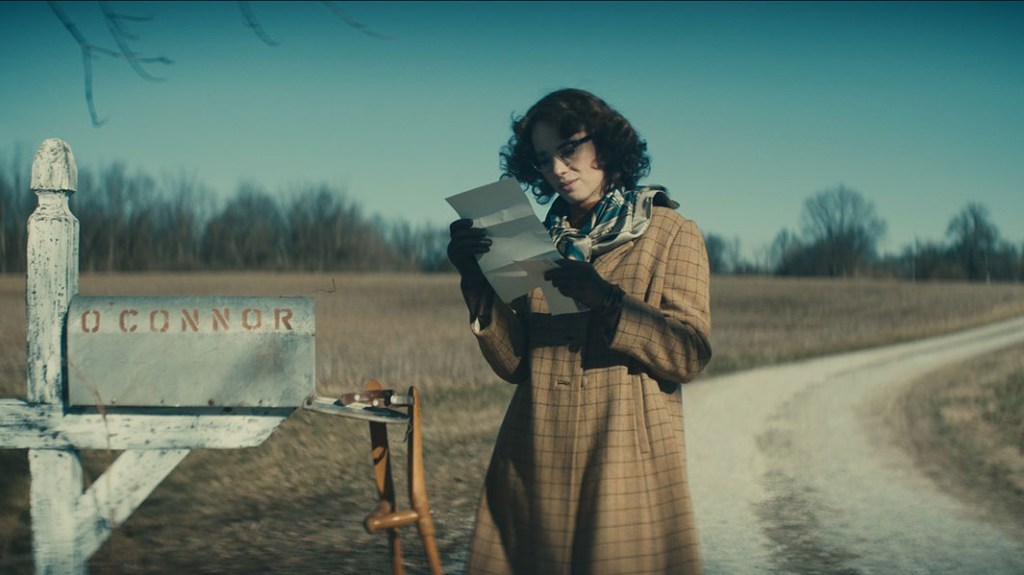
With another biopic this year, Ethan Hawke directs a unique rendition of the telling of a part of writer Flannery O’Connor’s history, with his daughter in the lead. Starring Maya Hawke as author O’Connor, Ethan Hawke’s Wildcat borrows its name from one of the acclaimed author’s first short stories from 1947, to tell the story of the author returning home as she struggles to become a writer in the city. Blurring the lines between real and fiction, Hawke’s take on O’Connor is clearly inspired and takes a step away from the traditional biopic outline. But although the film is visually stunning, these risks often do not always pan out, resulting in a film with pacing issues and an overall lack of a dramatic throughline.
Wildcat begins with Flannery O’Connor, played by Maya Hawke, returning home to her mother after time spent in the city. Dreaming of becoming an author, O’Connor grapples back home with her relationship with her mother, alongside new health concerns and her religious beliefs and upbringing as she faces new struggles related to her newfound condition. Along the way, the line is blurred between the real world and the world inside O’Connor’s head, where her stories live and are told on screen intercut with her new life back at home.
Hawke clearly had good intentions in his attempt to blur the real and the fictional world inside of O’Connor’s head. But in reflecting this on the screen, the film often gets lost in the fictional world, leaving viewers sometimes more invested in these stories than the actual life of the subject herself. This unfortunately results in a film that seems to lack a dramatic throughline, resulting in questions of what the goal of the film was in the first place, as not enough time it ever spent with O’Connor to create any true audience relationship with her in the first place. So while a unique twist on the traditional, and quite overdone, biopic, Hawke’s attempt at blurring the lines between the real and the fictional ends up being the film’s biggest fault.
There are inklings throughout the little time spent with O’Connor that would surely service the film and audience participation had they been explored more deeply. Events in O’Connor’s life like her diagnosis with Lupus, or her relationship with the church and her own religion, are all aspects that are there, but unfortunately undeveloped. This leaves viewers wanting more of this real-life story, coming to the end of the film needing more, but never inspired enough to seek out such further information on their own. Along with this, the younger Hawke’s performance is fine but doesn’t service the story much more than what is on the page, often failing to relay the true confusion and frustration of the young woman at the precipice of her career in her portrayal.
Visually the film is very nice to look at. Long shots that capture the world O’Connor both inhabits and creates in her head, as well as her character’s, as well as her own, places in these landscapes. The nature of O’Connor feeling confined and held back both in her hometown by those around her and by her illness are all accurately portrayed through the camera, leaving more time to be spent in O’Connor’s fictional world, with audiences understanding these constraints through the way O’Connor is shot. More generally, the colouring and lighting throughout the film are wonderful to look at, making it reminiscent of an older time and thus further immersing the viewer into the time O’Connor was living in.
Ethan Hawke’s latest entry into the world of directing places him behind the camera with his daughter in front of it. With Maya Hawke as writer Flannery O’Connor, Wildcat attempts to tell a personal story of a part of O’Connor’s history, by uniquely blending the real world with the fictional world within the head of the author. While well intentioned, this attempt to place a spin on the classic biographical outline ends up losing sight of what it set out to do, leaving audiences more enthralled with the world within O’Connor’s head than the actual real-life events of the well-known writer.
Wildcat was screened at the Toronto International Film Festival. Image courtesy of TIFF.

 After Screening Cinema