
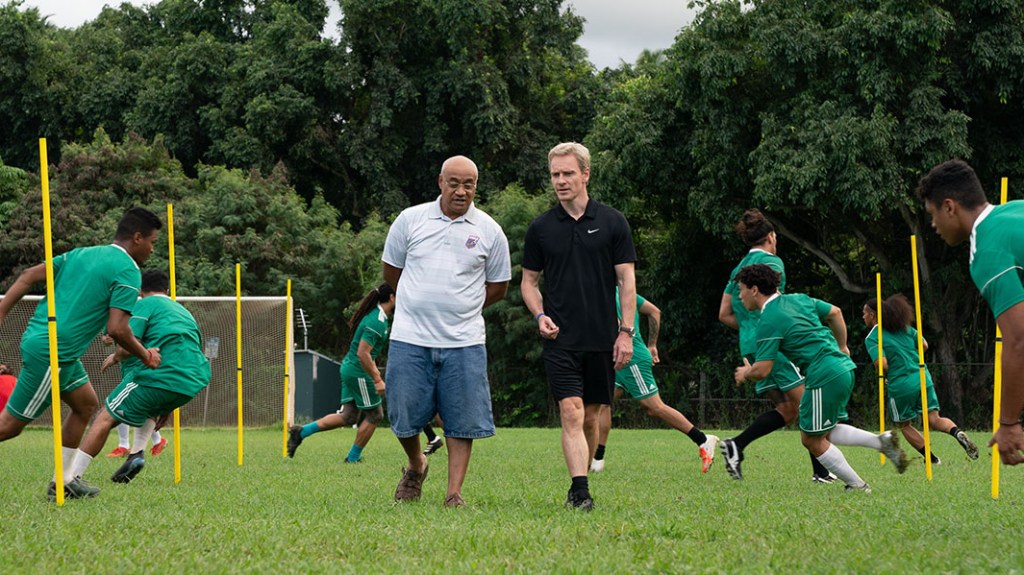
Next Goal Wins comes at a crucial time in the career of director and co-writer Taika Waititi. Following his acclaimed comedic drama Hunt For the Wilderpeople (2016) and Oscar-nominated film Jojo Rabbit (2019), viewers noticed a clear dip in the quality of films. Since then, his second Marvel Studios film, Thor: Love and Thunder, has gone on to earn a reputation as one of the worst films in the Marvel Cinematic Universe, leaving his next project one that would define his next steps in Hollywood. Unfortunately, Waititi’s latest, Next Goal Wins, fails to launch him back into the charm and heart at the core of his original films. Instead, it becomes one of his worst, with a screenplay too packed with attempts at witty jokes to ever allow his characters to shine. Despite this film being based on a true story, it fails to ever come off as more than a skit making fun of the very real people at the centre of the real life events.
Next Goal Wins is based on the true story of the American Samoa soccer team, known best for suffering what is known as the world’s biggest defeat in football history, losing to Australia in 2001, 31-0. Waititi’s film is based on the 2014 documentary of the same name, following coach Thomas Rongen as he coached the team to victory in 2011. With anger issues on the field prompting his relocation to American Samoa by his higher-ups, Rongen struggles to motivate the team, as they train for their next game, still facing the embarrassment of their brutal loss a decade earlier.
While Michael Fassbender does his best as coach Thomas Rongen with what he is given, he seems to lack any passion behind his performance, as Waititi fails to bring out any truly inspired performance we know is possible from performances in other historical sports films. The players on the team also give decent performances, but similarly are left with not much to work with. Despite it being a film about the team as much as it is about the coach, there is a severe lack of development of any player on the team, save one, the character of Jaiyah played by actor Kaimana. Jaiyah was the first openly transgender woman to compete in a FIFA World Cup qualifier, and while she seems to be the only player on the team given enough respect to warrant any character development, even her story is unfortunately told in a quite uninspired and rushed manner.
The screenplay is where the film truly lets down its players. The script is packed with far too many jokes, often not letting any single line be spoken without someone having to (attempt to ) crack a joke in response. It wouldn’t be as bad if the jokes were funny, but when the jokes-to-laughs ratio is this low in the first and second acts, there needs to be some rewriting. Waititi overall seems to go for the low-hanging fruit, making the easy and fast jokes that end up making fun of the team and the people of American Samoa far more than making jokes about anything of substance. This gets quite fatiguing, and character development is often brushed aside in the first two acts in favour of these quick remarks. By the end, the audience is far too fatigued to sit through their attempt in the third act to pull the film and its characters together with a go at a final impassioned team pep-talk.
This third act does give hope for what will possibly come next in Waitit’s career. The passion these players have for their game and country, and the loss and grief Rongen carries on his shoulders impact his performance as a coach is treated with care in the final minutes of the film, for what seems to be the first time in the film yet. In a return to the heart at the core of the story, prioritizing the humanity in this history rather than just the numbers or the jokes, Waititi reminds viewers that he is best when working with these very human stories, injecting a vein of comedy throughout to help make the experience of living through these very difficult aspects of being human a little bit easier. This small glimpse at the old Waititi, unfortunately, comes much too late in this film, with audiences at a point of just wanting the final true story end title cards to start rolling.
There is no doubt that you won’t watch the end of Taika Waititi’s 2023 Next Goal Wins and feel good. But the next inevitable question will soon arise, whether sitting through the first and second acts choked full of attempts at jokes and witty comments was worth it in the first place. At this point, it’s probably better to forego a screening of Next Goal Wins and instead watch the 2014 documentary of the same title, because at least you will leave the viewing knowing a respectable amount about the people at the core of this real-life story.
Next Goal Wins was screened at the Toronto International Film Festival. Image courtesy of TIFF.

 After Screening Cinema