
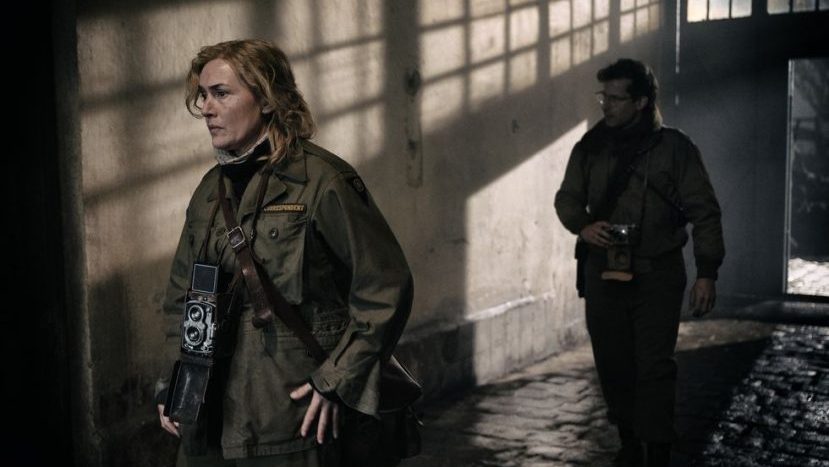
In what is continuing to be the year of the biopic comes Lee (2023), a passion project of star Kate Winslet directed by Ellen Kuras. Winslet plays Lee Miller, the model turned World War II photographer known for her historical documentation of Europe after the war. Focussing on some of the most prolific years of Lee’s life as a photographer, the film fills in the emotional gaps between some of the most famous photos captured by Lee in the 1940s. Despite Lee’s story never told in this form before, Kuras’ take is unfortunately quite average, taking a very by-the-books approach to tell Lee Miller’s one-of-a-kind historical story. It is the performances of Kate Winslet as Lee Miller, as well as a standout supporting performance from Andy Samberg as fellow photographer David Scherman that pulls the film together and keeps audiences captivated until the end.
Told in a flash back style as Lee Miller is being interviewed in her 1977 home, voice overs imbue an older voice of Lee onto the past, guiding viewers through some of the most prolific years of her career and life. Beginning in the late 1930s, Lee documents the transition of model Lee Miller into the world of photography, alongside her friends and new family. With the beginning and continuation of World War II, audiences follow Lee as she fights to be treated equally as her fellow male photographers, capturing sides of the war and those involved that could “only have been taken by a woman”. With the end of the war coming at the end of the second act, the third act of Lee dedicates itself to Lee’s monumental coverage through her photographs of Europe after the war, as a photographer crucial in first revealing the horrors of the Holocaust to a world wide audience.
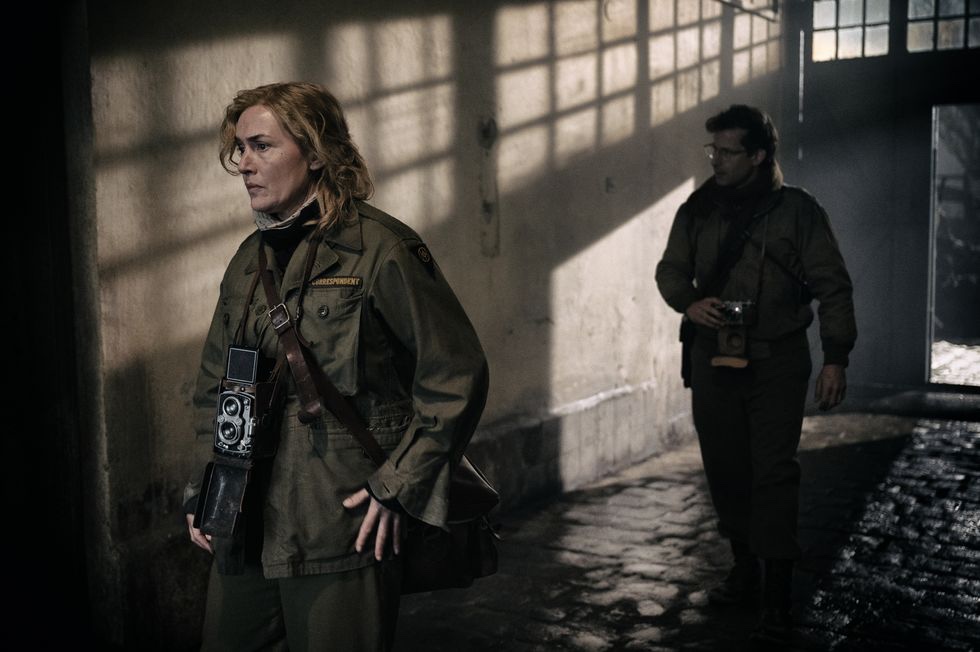
It is clear from the start that this film is filled with passion on the part of actor and producer Kate Winslet. She brings to life this historical figure of Lee Miller, so often framed into still images in a small corner of World War II history. Andy Samberg’s performance as Lee’s friend and fellow photographer David Scherman is a surprising standout of the film and remains grounded and with depth despite his past roles often taking a more comedic tone. Alexander Skarsgård as Roland Penrose, Lee’s husband, stands out only as a result of Skarsgård’s questionable British accent, but luckily is a character who becomes quite sparse in the film following the first act.
Those behind Lee seem to understand that many viewers have seen the photographs, or at least the most famous photographs, of Lee Miller. Especially in the third act, as Lee and her close friend and colleague David Scherman take photographs of the Dachau concentration camp in a post-war Germany, the film is never sensational in its treatment of Lee’s historical importance or what she captured on film. Rather than making a scene of recreating Lee’s most famous images, the photographs are each recreated on screen as Lee captures them for mere moments, before focussing instead on Lee and Scherman’s reactions. With the intent to fill in the gaps between these famous photographs to focus more on their human reactions rather than the images captured, the film does a solid job of forcing audiences to reckon with this real historical realization, experienced by so many, of the crimes committed in the Holocaust. Audiences have the chance to search the internet after seeing the film to see the real photographs and take them in on their own time, but Kuras’ film does a magnificent job, in the third act in particular, of focussing more on these gut-wrenching reactions of the photographers behind the real-life revolutionary images.

Lee does fall victim to an overly simple screenplay that presents Lee Miller’s extraordinary history in a quite lacklustre and predictable way. Attempting to add something new to this latest entry in the biopic race a “twist” in the nature of the interview concudted in 1977 is quite predictable by the time it is revealed, and comes off as quite gimmicky despite its clearly good-natured intentions. The first act and second act also become very unremarkable once the third act following Lee in post-war Germany arrives, in an act that is both narratively superior and works to bring out the best in Winslet and Samberg.
Lee is a film that a war-film enthusiast will most likely enjoy. Not sensational in its depiction of the war or the life of model-turned-photographer Lee Miller, it is accurately focussed on the most defining time in her career, the time spent covering World War II and post-war Europe. With strong performances at the centre of the film by Kate Winslet and Andy Samberg, it unfortunately feels quite slow until the third act of the film, in post-war Europe where it really seems to add something new to the story of Lee Miller. In common talks today about the importance of female filmmakers and how women’s experiences need to be told on the big screen by women, Lee Miller is a perfect example of why that so matters. Capturing aspects of the war and people involved through the point of view of a woman, she is celebrated both in the film and in the world today for her many photos that could have “only been taken by a woman”. Different histories lead to differently lived experiences, and Lee Miller’s story is one that proves the importance of capturing the world from new perspectives.
Lee was screened at the 2023 Toronto International Film Festival.
 After Screening Cinema