Mike Nichols and Elaine May. Known to many as a pair, their work stretched between underground comedy shows, the bright lights of Broadway, and the Silver-Screen of film. Despite this reputation as a pair, much success was gained for each through independent projects, including Nichols’ work on The Graduate (1967), and May’s work as a playwright and director, most notably for writing the one-act comedy Adaptation in 1968. As a result of their iconic history as a partnership, it comes as a surprise that Nichols did not direct one of May’s screenplays until 1996. This partnership would become the film The Birdcage, starring Nathan Lane and Robin Williams, based on the 1973 French play and its subsequent 1978 film adaptation, La Cage Aux Folles. While following almost identical narratives, the 1978 and 1996 films feature many stark contrasts, specifically in their use of the characters and their screenplays. Overall, May’s screenplay and Nichols’ direction seem to enhance the seemingly straightforward narrative of the original material, into a timeless, funny, and altogether heart-warming watch.
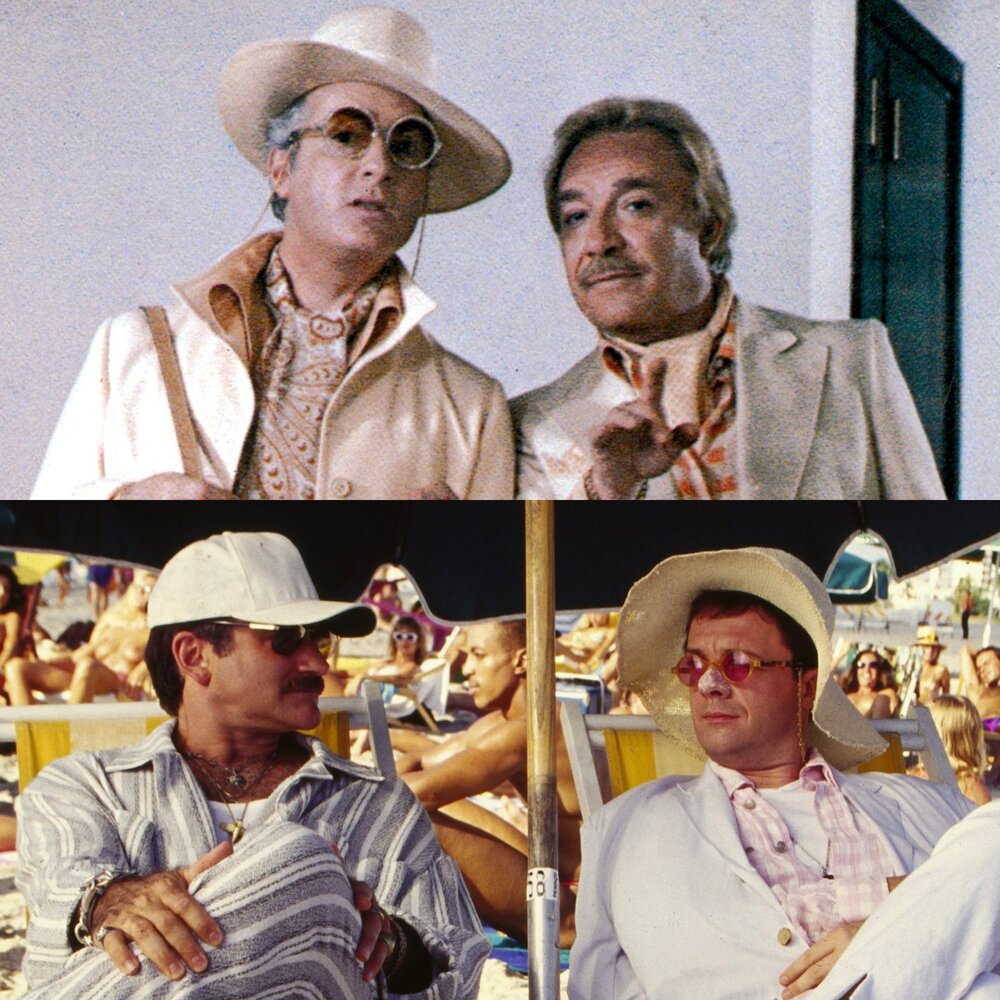
Bottom: Robin Williams and Nathan Lane in The Birdcage
Both La Cage aux Folles and The Birdcage follow a very similar plot. The stories follow a gay drag club owner and his partner, as they pretend to be straight for a night as they meet the family of their son’s fiance, who is the daughter of a very conservative, politically right winged couple. Hilarious conflicts arise throughout the evening between the couple about how to “act straight”, who the two fathers will be in relation to their son, and how their son’s biological mother will pay a role in the evening. The films conclude with a heartwarming acceptance of both fathers as parent, now equals in both their business and relationship. The 96 version stars Robin Williams and Nathan Lane, while the 78 version stars Ugo Tognazzi and Michel Serrault, with Serrault returning to his role of Albin from the 1973 stage play.
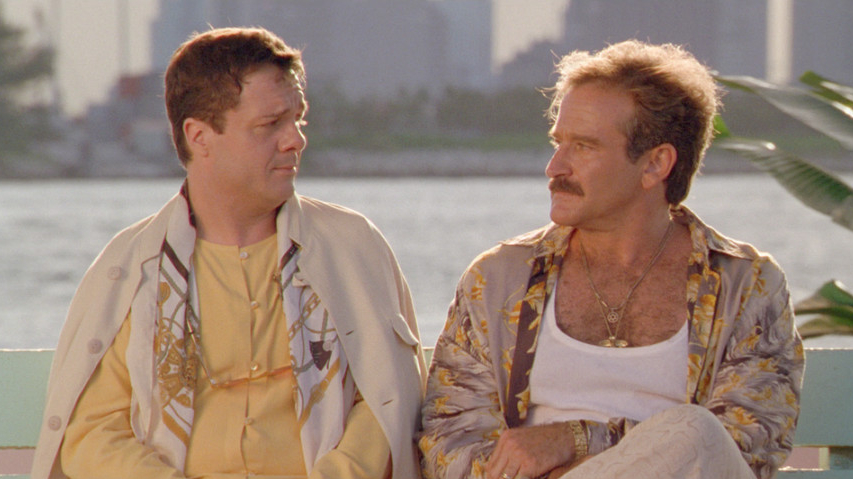
Overall, the narrative of both films remains very true to the original source material. The narrative arc of both films is almost identical, with the 1996 version 22 minutes longer. Rather than changing too much of the original film in terms of the overall narrative, screenwriter Elaine May instead seems to take moments in the original film and draw out as much comedy and commentary as she can. The 96 film takes the original story, set the South of France, and relocates the couple to Miami, Florida. This move comes with new cultural and political contexts, with the couple now owning a Drag club in 1990s United States of America, rather than France. May seems to revel in these these new political contexts, drawing out shorter and under-utilized scenes of the 78 film into longer ones, offering more hilarious and critical perspectives on those politically aligned with the extreme right. This includes a much longer series of events in the 96 version where the families wait for dinner to be ready, featuring many more jokes from Lane’s character, Albert, in Drag playing Val’s mother, about political positions in an attempt to appease Barbara’s parents. Opinions that sound absurd coming from the mouth of a gay man in drag, this critique is brutal, yet adds much-needed laughs in the 1978 sequence that was originally quite dull.
Aside from the increased awareness of the new political context, May’s screenplay and her change to the film’s overall context allow space for some of the more dull moments of the 1978 film to come to life in the 1996 version. A joke about bad coffee in the 78 version becomes a set up about Turkish coffee that Armand is not familiar with, and a delayed punchline with Albert recognizing the Turkish coffee in the 96 version. A joke featuring one of the male dancers chewing gum to “help him think” while rehearsing in the 78 version becomes a cheeky punchline from Albert in the 96 version, with Albert responding to this line, “sweetie, you’re wasting your gum”. A short scene in the 78 film of Renato coaching Albion in his performance becomes one of the most iconic scenes of the 96 film, featuring a hilarious dance from Robin Williams as Albert. It is unfortunate that a lot of these jokes are not present in the original 78 version. Not only this, but for the English-speaking viewer, a lot of the comedy will also be lost in translation, with non-French speaking viewers almost solely relying on subtitles to relay spoken jokes when watching the 78 version. While body language still translates, as well as the odd slap stick joke, overall much humour will be lost when the viewer does not speak the language spoken by the characters in the film. Despite these differences in languages, not only the amount of jokes between the two films, but also the differing quality and joke set ups seem to work much better for a modern audience with May behind the wheel.
Surprisingly, although it came later, the 1996 film seems to play much more strongly into its origins as a stage play. The film features many long-duration shots, lacking cuts in these scenes to close-ups or new perspectives. These long-duration shots seem to more closely mirror how one would view a stage play, taking in the setting and all the characters at once and in real time, and never relying on the camera cutting to a new shot to control the viewer’s gaze and direct them to something specific. The viewer can take in these long-duration shots, experiencing the character’s interactions in real time, without constant cuts that would be non existent in a real life stage play. The long-duration opening shot, with the camera winding around patrons and queens alike in The Birdcage club, or the scene of Robin Williams as Armand directing Albert, the shots seem to linger much more than we would expect to see in a film, where nowadays viewers are used to shots which last for much shorter lengths. Compared to the 96 version, the 78 version seems to utilize its camera much less to feign a stage play experience. The editing and duration of shots seems very typical in the 78 version, with much less emphasis on relaying the experience of watching a play live on stage.
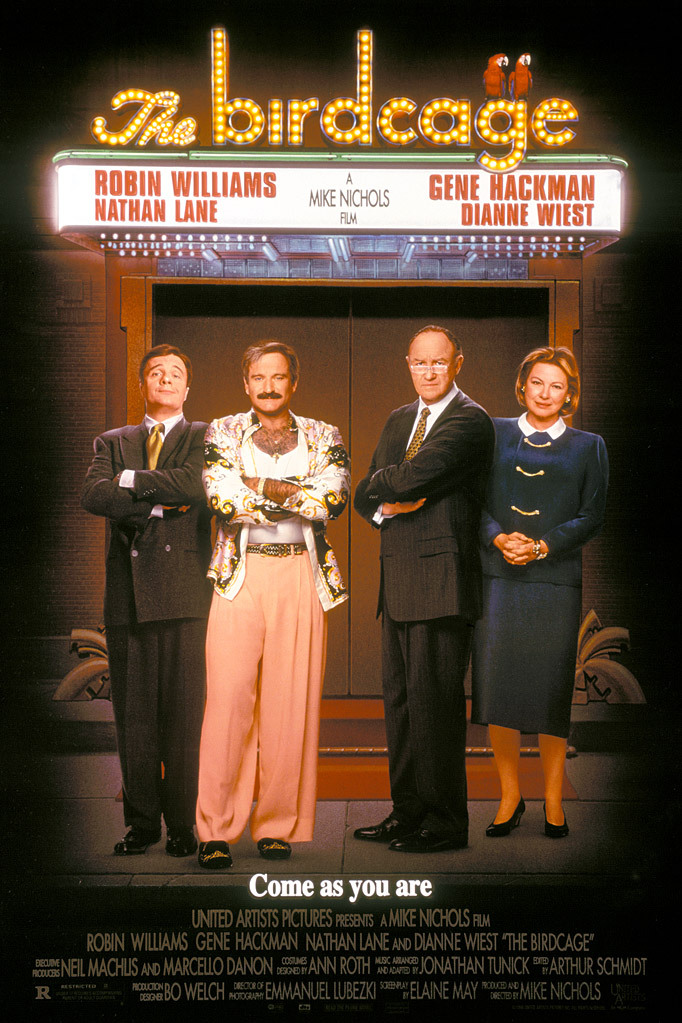

Overall, both La Cage aux Folles and The Birdcage are hilarious, heart-warming, and relevant films. While remaining very similar in their narratives, the French version seems to lack in a comparison between the two films, coming out with less jokes, or failing to fully draw out all they can from moments just waiting to be much more funny. While both contain critiques of those aligned with the far right politically, the American version manages to draw out much more from some of the shorter scenes to provide more relevant critiques and jokes different groups of people. It is nice to see that neither film ever strays far away from the original narrative from the stage play, and neither ever becomes mean or too self-serious given the subject matter they are dealing with. Rather, both succeed in providing a critical yet hilarious look at the state of the world in both 1978 and 1996, as well as still being relevant today. Screenwriter for the 1996 version Elaine May seems to fully understand her source material, and beautifully adapts the original story into an American political context of the late 90s. She takes the best moments of the original film and play, and is able to draw every last drop of critique and comedy out of these moments, while still remaining true to the heart at the core of the story, and the love between these two drag club owners. While The Birdcage (1996) comes out on top in a modern context, I am forever grateful for these stories, dating back to the early 1970s, providing stories that share tales of things other than heartbreak and despair for queer couples, making for a guaranteed fun and hilarious watch. Every time.
 After Screening Cinema