
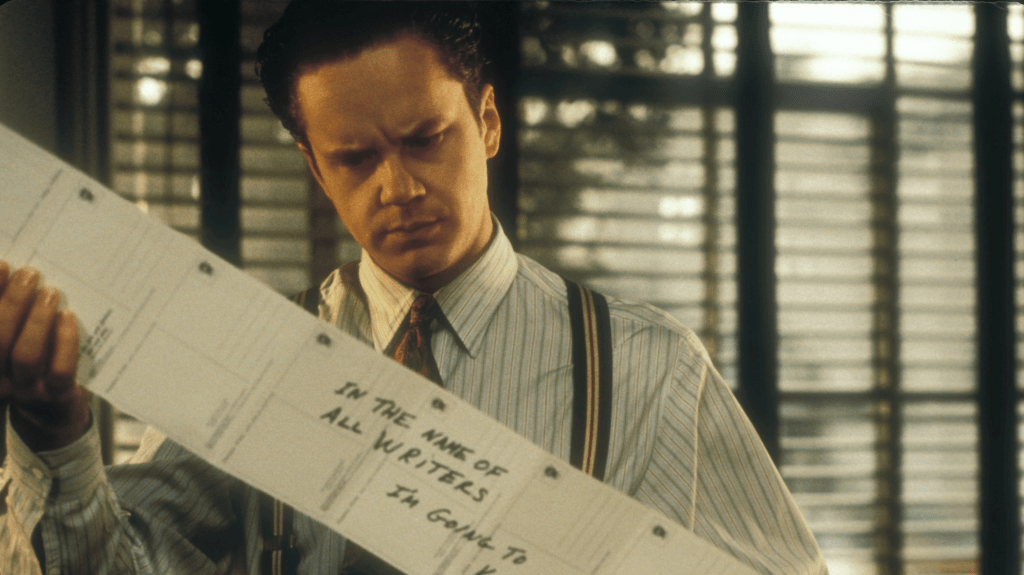
One of the most interesting ways a films can age is not when it becomes more problematic, or more removed from the present state of the world, but rather when a critique it makes or topic it satirizes becomes all the more scathing, proving to be even more true as time has passed. This is the case for Robert Altman’s 1992 film, The Player, known as his grand middle-finger gesture to the industry, studio intentions, and Hollywood around him. The Player follows Griffin Mill, a top studio exec at a huge movie studio, who gets caught up in a game of crime and murder, as he begins to receive threatening postcards from a writer he never called back, and wrongly assumes which writer is sending these treats. The film follows Mill’s spiral into an obsession over the postcards, and the actions he took following his meeting with the writer, commenting on the both the state of Hollywood, and the place of writers in studio films.
Robert Altman’s critique in his film is obvious, and it is scathing. With a writer threatening a producer after his script was not taken past the initial meeting, the producer’s steps to silence the writer and move towards a future of Hollywood with no writers at all are scary. The film eerily mirrors the real life treatment of writers, cast aside by studio execs, only searching for their next project that will be guaranteed to bring in billions of dollars. The literal silencing of the writer by Mill, and his stories, comes with it Altman’s critique of Hollywood in general, assumed to many to be a place where everyone’s story can get told on the big screen, by passionate writers intending to reflect the state of the world in their art. Well, only if the film tests well… And it better have a sex scene… And at least two big movie stars… And a happy ending, because nobody wants to leave the theatre feeling sad… And maybe a few callbacks to older films too.
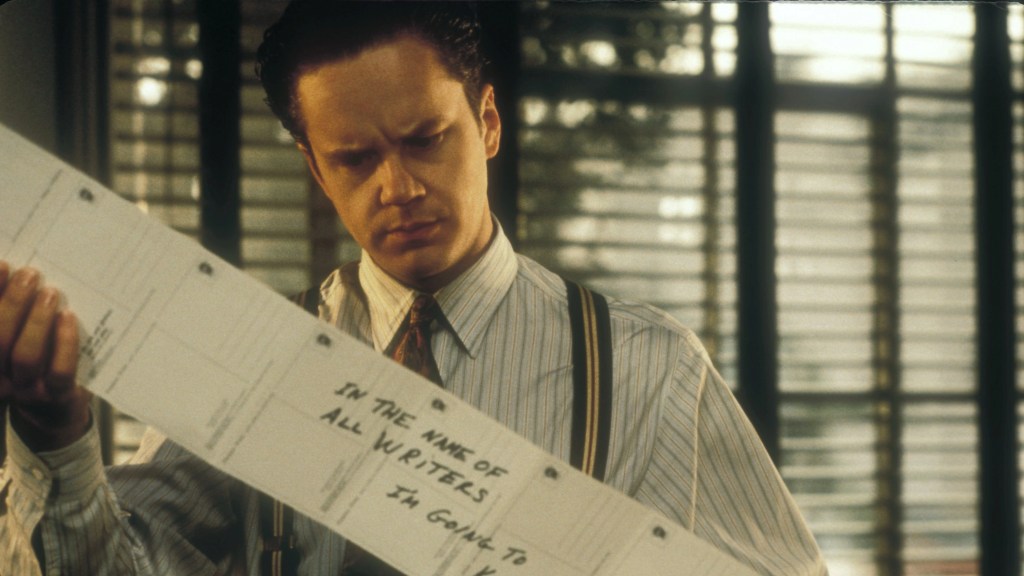
Tim Robbin’s performance as Griffin Mill is terrifyingly uncanny. As absurd as this character and his actions are, one can’t help but compare him to the likes of studio execs and higher ups in almost any industry, as the power hungry men with only one goal: to make more money. Robbins so clearly captures this power and status, while never failing to make the viewer totally uncomfortable with his actions and the ways he reacts to the events around him. In his spiral to the bottom, he maintains composure in the most horrifying way, mirroring a lack of responsibility and empathy often seen in many of these wealthy, power-hungry leaders we still see today. The ensemble cast, bringing in the likes of actors including Whoopi Goldberg, Bruce Willis, Julia Roberts, Lily Tomlin, and countless others, offers such a fun and unique take on the Hollywood satire, with actors playing both characters or themselves, in their respective roles within this fictional movie studio.
In reflecting on The Player and its translation to audiences in 2023, Altman’s satirical qualities of his 1992 film are unfortunately still relevant today. In the last few years, there has been a seeming obsessions with sequels and old stories, reviving past casts for viewer satisfaction, and franchising everything to churn out even more content, merchandise, and even theme park rides. 2023 alone seems to be the year of the biopic, translating pre-existing true stories of the real life people behind Tetris, famous physicists, Flamin’ Hot Cheetos, the BlackBerry team, and more. Growing talks of AI replacing writers, as well as a rapidly changing industry with the rise of streaming streaming, writers in Hollywood are amidst constant renegotiating of terms to be adequately compensated for their work. In a scene of The Player, as the producers discuss a Hollywood free of writers, they take to the newspaper, to show that any story from the news can be turned into a spectacle by any person, eliminating the need for writers and their creative, new stories. The industry is about money, and what will bring in the most money, rather than taking into account new and inspiring stories that talk to actual real world issues. For these producers, it doesn’t matter what the writer’s intentions were, or how their original ending would speak to real world experiences, but instead if the film tests well with audiences, no matter what the ending, then it is sure to be a hit.
The Player premiered in 1992, but the state of Hollywood in 2023 brings the perfect atmosphere for a re-watch or first-time viewing of this beloved classic from Altman. In a time where many people online are calling for change in the industry, to move away from sequels and reboots and instead invest in new and unique material, Altman’s critiques of the Hollywood in The Player still remain true to this day. Today, some people are calling for a “Hollywood New Wave”, a new movement of filmmakers who will largely reject big-budget blockbuster films funding sequels and remakes, to instead invest their time and passions to work on new stories in film more independently. A movement that could, retroactively and pending the upcoming few years of film, be looked at to have started with films amongst the likes of 2022’s Everything Everywhere All at Once and TAR. There is corruption at the core of the Hollywood industry, and this is so plainly shown by Griffin Mill in The Player. Films have the power to to good in the world, and audiences have the power, through their movie tickets, to influence the higher-ups to invest in unique stories and new voices, rather than franchises and sequels. A new film movement of independent and never-before-told stories may be coming, and The Player (1992) perfectly captures and satirizes the state of studios and Hollywood on the precipice of this jump into new and exciting territory.
 After Screening Cinema