

What if a body was viewed to most as a mere machine? One running gears, to be fed with power, and with a timer counting down the seconds until it would stop functioning as evolution required forever. For many women, this is life, experiencing pressures from society to have children before their “biological clock”, the natural timing devices in their bodies allowing for the possibility of having children, runs out. Alexis Jacknow’s most recent film Clock takes a horror spin on this societal expectation, following Diana Agron as Ella, a woman who has never wanted children, as she enters a clinical trial aimed towards cognitively fix her decision of not wanting children, before the time on her biological clock runs out. While the approach to this topic from a horror point of view is unique and it’s commentary on the societal expectations on women of child bearing age is true, the film takes itself much too seriously, resulting in a predictable view of an unsettling societal subject.
Alexis Jacknow’s most recent 2023 film stars Diana Agron as Ella Patel, a woman with no yearning to become a mother, surrounded by people pressuring her to not let her biological clock run out of time. In an attempt to “fix” her mentality towards having a child, she agrees to take part in a clinical trial, to cognitively and medically alter her view towards this aspect of her life. As the medication seems to begins working, Ella begins to experience horrifying side effects, as she questions those around her and her true feelings towards becoming a mother. Diana Agron gives a stunning and heart breaking performance as Ella, standing out in this film alongside a lack-lustre script to pull emotion and empathy from the viewer throughout. While the story leans towards the more predictable, with unnecessary and quite obvious foreshadowing in the first scenes of the film, it is Agron’s performance as this woman tortured by societal expectations that carries audience attention to the end.
The commentary Jacknow and Clock is making on women and their place in society as more than just child-rearing machines is scathing, and obvious. If women are simply seen as clocks, with gears and parts inside needing to function properly, how are those that function differently looked at? Is it not society who are broken if they cannot accept those who do not children, rather than the woman’s body as broken if she does not want this fate? The horror genre is an intriguing avenue to take when exploring this horrifying societal issue, and while the film never loses sight of this critique it makes, the predictable and often times dull script make it seem like a story which would have been much more successfully explored had it been a short episode of a series like Black Mirror. Taking itself much too seriously, had the film leaned much more into its existence as a satire of the conditions of today’s society, rather than diving straight into being a self-serious modern horror on child-bearing, it seems it would have succeeded much more in both making a strong critique on these expectations, while still presenting the horrifying experiences of many women today.
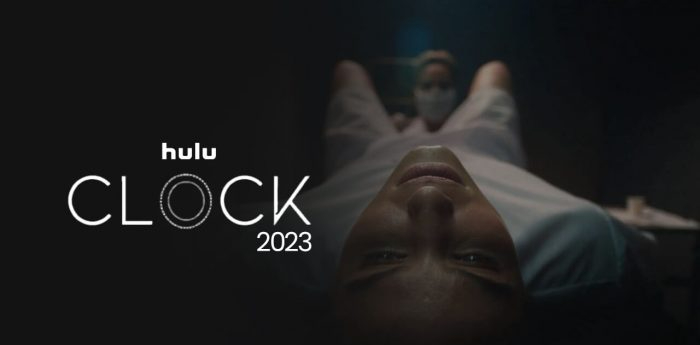
Colouring and overall cinematography are used in an interesting yet quite predictable way. With bright, light colours at the beginning coexisting with Ella not wanting a baby, the colour is drained from both her world and the world of the film as her treatment and perspectives on having a child change. As the treatment progresses, Ella wants a child more, but experiences gruesome side effects as the colours of the film shift more towards grayscale. She is getting what she wants, but as she does, the bright colours of her life are drained away. This formal shift elevates Jacknow’s commentary, but this fairly basic use of colours is not pushing any boundaries, with reveals and twists at the end of the film pushing this use of colour as a symbol much too heavily down the throats of viewers.
The use of a grandfather clock as a ticking-down family heirloom used to relay the experiences of Ella feeling as through she is failing in continuing her family line is a simple but still effective. As a descendant of two Holocaust survivors, Ella feels guilt knowing that she does not want children, feeling as she is failing to continue her family line that survived through such brutal historical conditions, the genocide that was the Holocaust. This complicates both the character of Ella and the story, and is a difficult topic often not discussed in films of this genre that is handled with such respect and truth. The film is never subtle in its approach to this difficult topic, which works in making its blistering critique on the modern society much stronger, but this lack of subtlety removes any possible room for audience’s personal interactions with a more subtle text.
Clock (2023) takes the all too familiar pressures placed on women who do not want children within a broken society that assumes every woman to yearns to be a mother, and places them in the realm of horror film. Telling this story alongside historical elements of genocide and the Holocaust, while Diana Agron’s performance keeps audiences rooting for this struggling woman, the predictable use of foreshadowing and colouring throughout the film takes away from the more scathing critique the film could have made, had it, say, leaned more into its satirical elements rather than horror and been slightly more subtle in its critique. The film presents these issues from a thrilling perspective with historical contexts devastatingly relatable for many viewers, but fails to do so in a way that is breaking any barriers. Alexis Jacknow’s Clock is a strong contender in the world of streaming horror films, but in taking itself much too seriously, apart from its stellar return to the star role by Diana Agron, fails to make any sort of commentary that goes deeper than surface level.
Clock (2023) is now available to stream on Disney+ in Canada.
 After Screening Cinema