
The latest film to highlight Nintendo and a story of video game legacy featuring a car chase, theft, and a race against the clock has hit home release. But spoiler alert: this isn’t the new Mario movie. Tetris (2023) is the latest film from director Jon S. Baird, detailing the history of the game Tetris. Coming at the start of what seems to be the year of the biopic, Tetris tells the story of Henk Rogers, working with Nintendo and racing against the likes of the billionaire father and son of Mirrorsoft, Sega, and independent distributors to obtain the video game and handheld rights to Tetris in the late 1980s from ELORG in the USSR. While Taron Egerton of Rocketman as Henk Rogers manages to keep the film moving and viewers captivated by this inspired real life business man, the pacing of the film and overall tonal shifts make it difficult to leave a viewing of this film without wondering, was this biopic really necessary?
The film is at its best when it plays into its more absurd aspects. While based on the true story of the tense negotiations surrounding the rights to Tetris from the USSR, the film still seems, at times, to recognize the absurdity of the story it is telling. The fact that all of this, the tension, the stress, the corruption, is all surrounding Tetris. The game with four little blocks and a grid. The beginning of the film plays well into the quirky side of Rogers’ personality, his willingness to take risks and his passion for software and video games. But the second act quickly takes a turn, transforming the following 90 minutes of the film into an intense political thriller with a huge tonal shift from the first 30 minutes. While still relaying the truth of the history of Tetris, the tonal shift feels forced, slowing the pacing of the film and detaching itself from the originally more quirky aspects of the history and its players. The final 10 minutes of the film seems to return to this heart, featuring a car chase through Moscow that leaves viewers running to Google to see if it actually happened.

The editing does not help with this halt in pacing the film takes in its second and third acts. At the beginning of the film, scenes are edited together with transitions featuring Tetris blocks and characters are introduced as players in a video game. Who will come out on top, and who will win the game? This expected yet unorthodox form of editing, especially in a drama film, adds a fun flare to the first act of the film, grounding the story in its roots of the very video game they are detailing. This eccentricity of the editing is quickly lost as the film shifts tones to a more political landscape, and begins to take itself far too seriously. While still featuring the sporadic Tetris block composition of a building in a scene transition, they feel forced and out of place, and the viewer is left forgetting completely about our competitors introduced as players in the game, until one of the final scenes of the film, when one player comes out on top.
Despite its flaws in its pacing, film still remains interesting throughout its runtime. A history so absurd, it is fascinating to learn that all of this went down over the rights to a video game. The real life people behind the story are just as important as the rich political history in which this video game survived through, and the film surprisingly achieves an enthralling critique on political corruption, communism, and the impacts of capitalism on those at the inception of the great ideas of the future. So it is unfortunate that in its adaptation to the screen, the film seems to fall short of not knowing what exactly it is aiming to accomplish. Telling the story of Henk Rogers? Creating a political piece detailing corruption in the USSR in the 1980s? A race-against-the-clock video game thriller? It seems to go for all of these and more, leaving a film that feels like it doesn’t know where it stands, trying to play into every aspects, but thus falling short in its pacing and ability to garner any deeper emotions towards Henk or Tetris’ complicated history.
Taron Egerton carries the film, relaying the story of the overly ambitious and oftentimes too American Henk Rogers, navigating his cultural divide in the world of politics and business in 1980s Russia. Nikita Efremov as Alexy Pajitnov, the original creator of Tetris in the USSR shines alongside Egerton, portraying the difficult real-life experiences of Pajitnov and his family, living in Russia in the 1980s. The two men play off of each other very well, playing the part of the overly emotional American and the stoic Russian sharing the screen and coming to trust each other and their intentions with such ease, but it is a shame they are both hindered by a film seeming to play into the wrong aspects of its absurd yet complicated history.
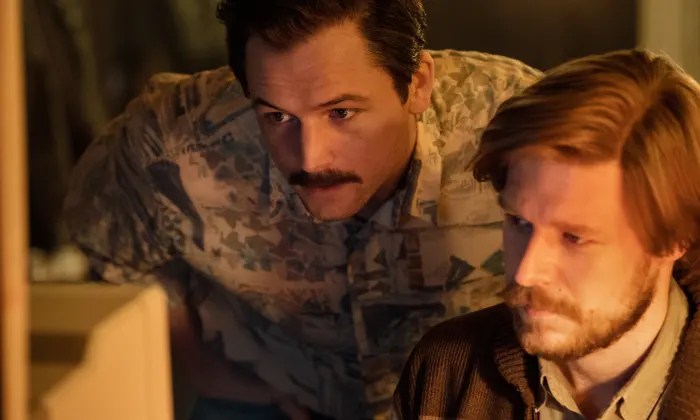
Tetris (2023) is an unexpected ride. Telling the fairly unknown story of the origins of Tetris and the battle between multi-million-dollar companies for video game and handheld rights, the story it tells of political corruption and abuse of power is often unbelievable. While the history of the game is quite unusual and unexpected, the film unfortunately falls flat in its execution, featuring large tonal shifts between acts that seem to halt the pacing the first act sets up. And while the history is relayed quite clearly in the film, it is a good question to ask whether this film about Henk Rogers, one of the first of many biopics to be made this year, even needed to be made in the first place. Because if a history is more interesting to read about on Wikipedia, does it really need a film adaptation at all?
Tetris (2023) is now available to stream on Apple TV+ in Canada.
 After Screening Cinema