
Branden Cronenberg is back with his latest feature Infinity Pool, and as expected, filled with almost every bodily fluid, blood, violence, and sex. In this latest film, Cronenberg tackles the latest seeming trend in media from last year, commentary on the lives and privileges of the ultra-rich.
Infinity Pool follows couple James and Em Foster, played by Alexander Skarsgård and Cleopatra Coleman, on vacation in the fictional country of Li Tolqa, where they meet Gabi, played by Mia Goth, and her husband Alban. After accidentally taking part in an illegal act, James is arrested, and forced to decide by authorities whether he will be executed, or pay an obscene amount of money to have the government create a “double” of him to be executed instead. After choosing the latter, James is taken on a whirlwind of a ride alongside other rich, western tourists, exploiting the rules and offerings of this country and government, and facing the dark world taking part in the exploitation of the small island country.
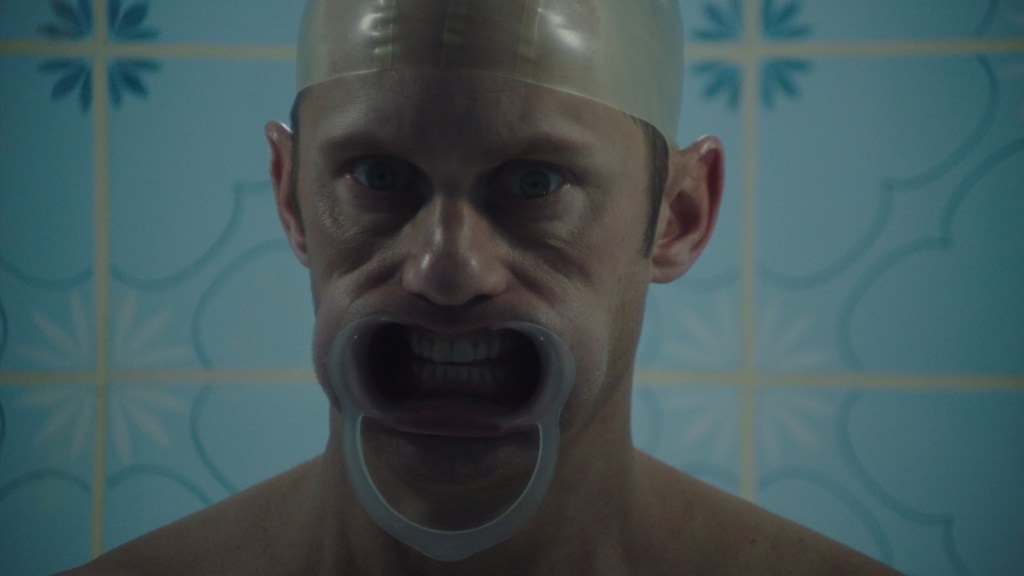
Our group of rich tourists seem to think they have it all. The characters continue to break laws, knowing they hav the means to continually fork over large sums of money to continue experiencing the executions of their doubles rather than themselves. For James, this world of illegal activities, sex, drugs, and freedom from the law, which begins as all he could ever hope for, quickly becomes a world he both need to escape but cannot seem ti live without. And while out rich characters seem to have it all, it is instead the government of Li Tolqa, knowing they have the power to overlook crimes on their own people of these wealthy tourists in exchange for absurd amounts of money that will help themselves and their country, that are truly in power. What is devastating about this is both the understanding that the country knows it is exploited by western countries and its tourists. This lack of care towards the island and its inhabitants has clearly occurred, in a time before the events of the film, so much resulting in the government taking matters into their own hands and taking advantage of these people right back, exploiting their exuberant wealth. Whether this is right or not is besides the point of the all to real commentary this film makes on the current state of the world. Far too often do those with more money and power feel entitled to never have to face the consequences of their actions, instead avoiding the consequences altogether using their money and power over others. This unfortunate facet of our society has continues to grow and become more common, enabling abusers in the workplace, allowing the rich to “buy” their kids ways into colleges, and keeping the wealth of the world in the hands of the top 1%. Cronenberg’s Infinity Pool is painfully aware of the state of the riches of the world and uses its narrative and unlikeable rich characters to comment on how the world has let it go too far.
Alongside this critique of wealth, Cronenberg’s narrative does not stray away from a more personal conquest. With his place in the industry as a nepotism baby as the son of David Cronenberg, known similarity for his unique and grotesque works of horror, Brandon Cronenberg seems be fully aware of the privilege he has because of this. Weaved throughout the narrative, a commentary on not only the lives of these rich western tourists, but also a commentary on having certain doors open simply because of one’s connections. Although James is an author, he has failed to write a novel past his debut. Commenting at dinner one night, his wife Em mentions that he married into wealth, allowing James to remain a (failed) author. So regardless of the money James seems to have to be able to take part in each “doubling”, we are forced to reckon with the fact that this is probably not his money at all, but rather his wife’s. How different would James’ life in Li Tolqa look if it weren’t for this money, these opportunities that he married into? Without Em, James probably wouldn’t have made it out of the first act of this film. Rather, James probably would not be on this vacation, if it weren’t for his wife’s money, allowing him both this vacation and the ability to be an “author”, of only one failed book, rather than being forced out of his own pity party to find a job to support himself. And with a director like Brandon Cronenberg, these commentaries seem that much more personal. Working through the knowledge that doors were opened for him in large part because of his father, and who he is in the industry, this stark commentary alongside that on the ultra-rich, is both personal and powerful in the context of director’s place in the film industry.

Infinity Pool is the newest addition to the recent influx of films about the ultra-rich. Filled with greed, sex, blood, and violence, the film is anything but an easy watch, but all to be expected from the mind of Brandon Cronenberg. Never veering away from a critique on the exploitation of smaller, less-wealthy countries by rich, privileged, western tourists, the film also indulges, in a more nuanced way, very real anxieties of B. Cronenberg, grappling with his place in the film industry as a nepotism baby, as the son of acclaimed director David Cronenberg. While the film struggles in some ways trying to pack too much into its sub 2-hour run time, not leaving the audience quite enough time to truly take in and react to each grotesque story arc, the film makes for a grotesque yet enthralling ride through the twisted lives of the wealthy, entitled on a dizzying and unique vacation.
Infinity Pool (2023) is now playing in theatres across Canada.
 After Screening Cinema