

This review was written as part of my course on Cinema & Migration, for an assignment to write a 500 word film review discussing how the formal techniques of a chosen film on migration create my impression of the film, and how these technical choices relate to the themes of the film, helping it to accomplish its work.
Brooklyn (2015), directed by John Crowley and based on the novel by Colm Tolbin of the same title, follows a young Irish immigrant who leaves Ireland to find work in Brooklyn, USA. Brooklyn is a personal, tragic, and inspiring story, not only a story of one’s move across oceans to seek work, but also a story of coming-of-age, and love, that I believe any viewer can relate to, no matter where they call home. Through not only its narrative but also the technical aspects, this gripping and emotional film highlights the common immigrant experience of being torn between identities and coming to find one’s own place in the world, despite a fractured feeling of identity.
Saoirse Ronan stars as Eilis, a young girl, born and raised in a small town in Ireland in the 1950s. Eilis leaves behind the familiarity of Ireland as well as her mother and sister, as she seeks work and faces homesickness across the Atlantic in Brooklyn, USA. Slowly, Eilis warms to Brooklyn, meeting new friends and lovers, and finding new comforts despite her distance from her family. But when faced with the prospect of returning to Ireland, Eilis struggles to decide where, and with whom, she truly calls home.

Some major technical decisions in this film beautifully complement the themes of being torn between identities and struggling to find a place in the world while coming of age after migration. The editing of the film helps the film to accomplish relaying Eilis’ feelings of being torn between identities. There are a few instances in the film where Eilis is at a low point, and the image of her face dissolves onto the face of someone she cares for who lives far away, like her mother in Ireland, or her boyfriend in Brooklyn. These editing choices act to remind us that Eilis is not just made up of her own identity, but has also been shaped by those around her, and the different places she has lived. In these hard times, she years for her family an ocean away, or her boyfriend, who comes from a completely different country than her, feelings uniquely embodied in the film through the editing and the use of dissolves from Eilis’ face to another’s.
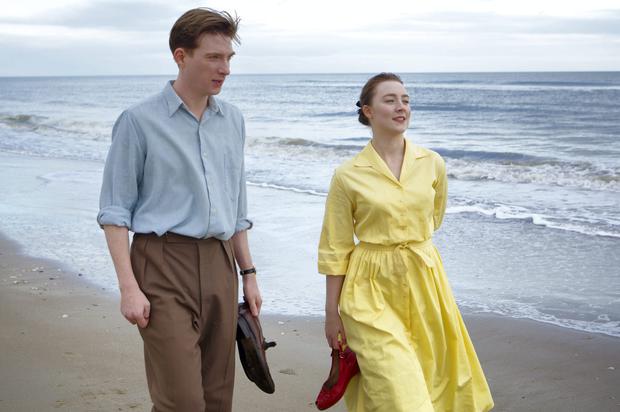
The mise-en-scène, and especially the use of the colours of Eilis’ costumes in the film, also helps to relay her search for identity and the overall theme of being torn between identities. When Eilis is first in Ireland, her clothes are subtle, seen wearing dull pinks and blues that do not stand out. As she moves to Brooklyn, she carries these dull colours, and thus her old identity, with her. As she makes new friends and meets new romantic partners, and becomes more comfortable in Brooklyn, we slowly see a shift to brighter colours and more flattering clothes. When she returns to Ireland, she brings these new colours, and a sense of her newfound confidence in her own identity with her, which she has found in discovering herself and her interests outside of Ireland.
Brooklyn is a wonderful film I highly recommend that relays many of the experiences of young immigrants finding their identity, in an accessible and unpretentious way. Using technical aspects of the film, like editing, mise-en-scène, and colours, Crowley beautifully crafts these technical aspects of the film to complement the themes of being torn between identities and searching for a new home despite a deep love for and connection with the old one.
 After Screening Cinema